HookGenius · Studio
Do Your AI Songs Sound Like Everybody’s? Here’s How to Make One That Sounds Like Your Life
It isn’t about writing a better prompt. It’s about what’s on the other side of it. Here’s the difference, on a real song from last night.
By Jesse Meria, founder of HookGenius · October 21, 2026
A lot of AI songs start to sound alike.
It isn’t about how well you ask. In my experience it doesn’t matter which AI it is: you can describe a song perfectly and still get something that sounds like one tool doing its best on its own. Because that’s what it is.
A song needs a lot of things to go right that you’d never think to ask for. The structure. The sound. Who sings what. How every line is delivered. One AI working alone tries to cover all of it at once, and improvises the rest.
HookGenius isn’t one AI improvising. It’s a whole system, built around everything we’ve learned about how a song actually gets made. You bring the idea. It does the rest.
You can give it one word, or as much context as you have. Here’s what that looks like on a real song from last night.
1. Say it the way you’d say it to a friend
Behind the box in HookGenius is a whole production team’s worth of know-how, built and tuned through thousands of changes. I’m not going to tell you everything that’s in there. You don’t need to know. You just talk.
I don’t type to my computer, I talk to it, so this is exactly what I said:
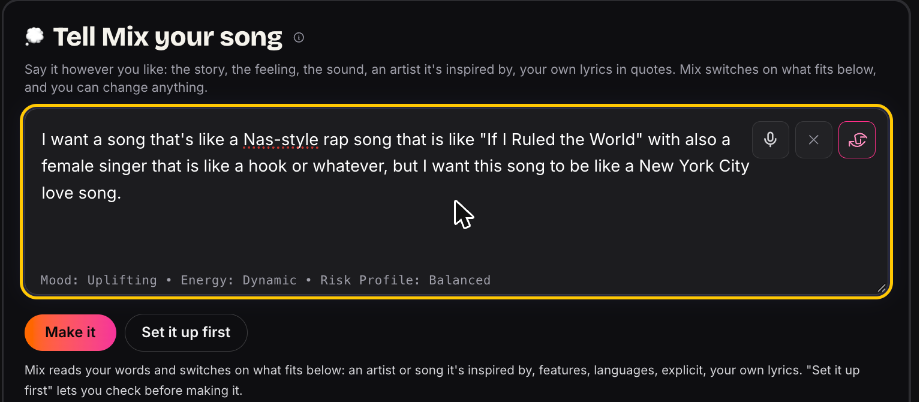
That’s it. No settings, no genre menus. In the new HookGenius Studio there’s a producer you talk to, called Mix. From that one sentence, Mix switched on what the song needed by itself:
- Rap feature on: a featured rapper gets a verse.
- Featured singer on: a guest voice gets their own part.
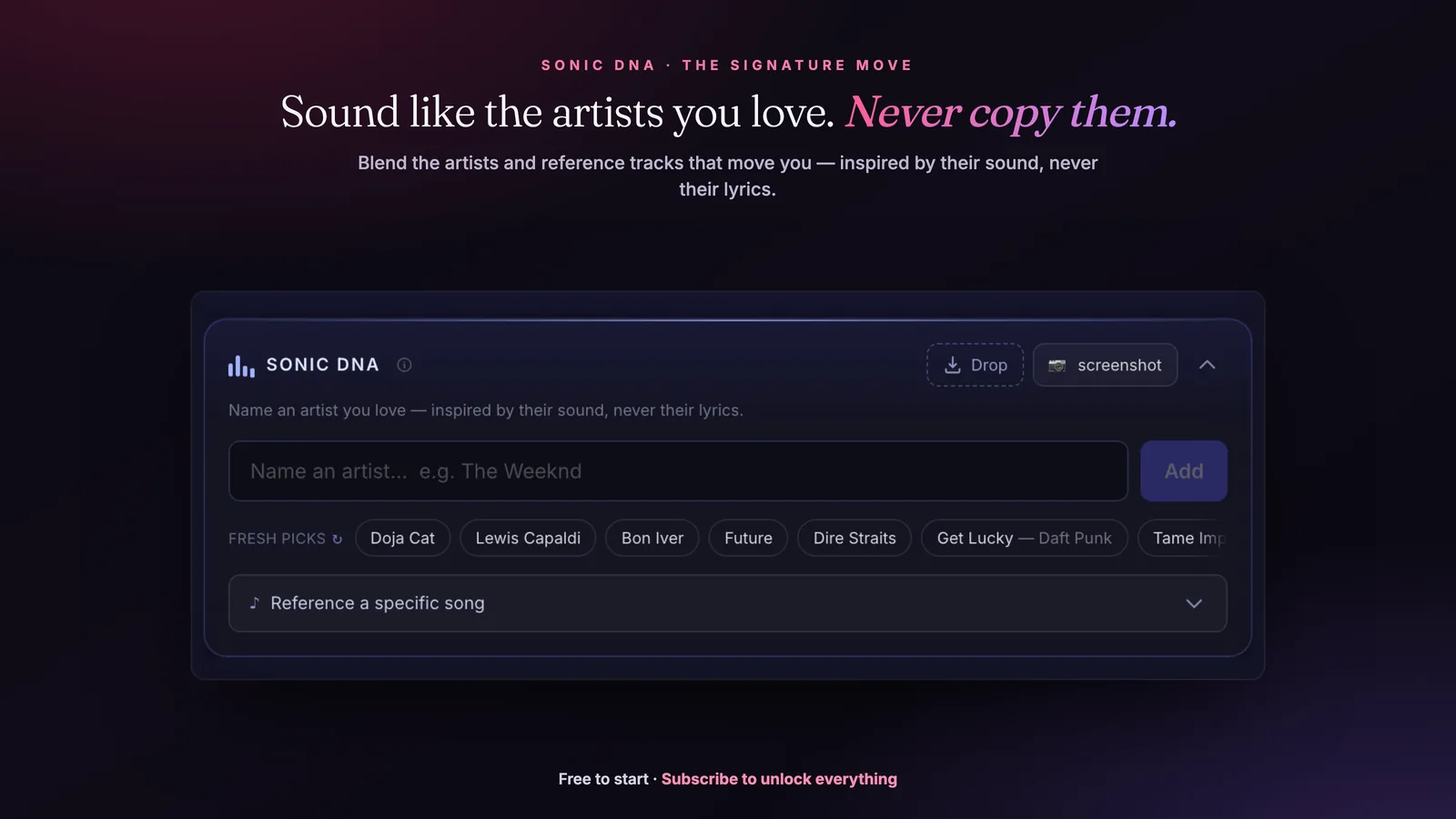
- It looked up the record I named and built from its sound: “Mid-tempo East Coast hip-hop built on a soul-sourced sample loop.”
2. Read what comes back, honestly
A minute later I had a whole song: three rap verses, a woman singing the hook, a bridge, and directions for how every part should be played and sung. The hook:
Meet me uptown when the trains run slow
Corner of the world, only place I know
Good. But it’s somebody’s New York: the A train, the Apollo, a stoop in summer. Not mine.
3. Ask for a remix
Then I asked Mix for a remix:
“How about we make a new one. Same inspiration but I want this one to mention Banter in Murray Hill neighborhood and the Highline and the Chelsea market.”
Now the first verse opens at Banter:
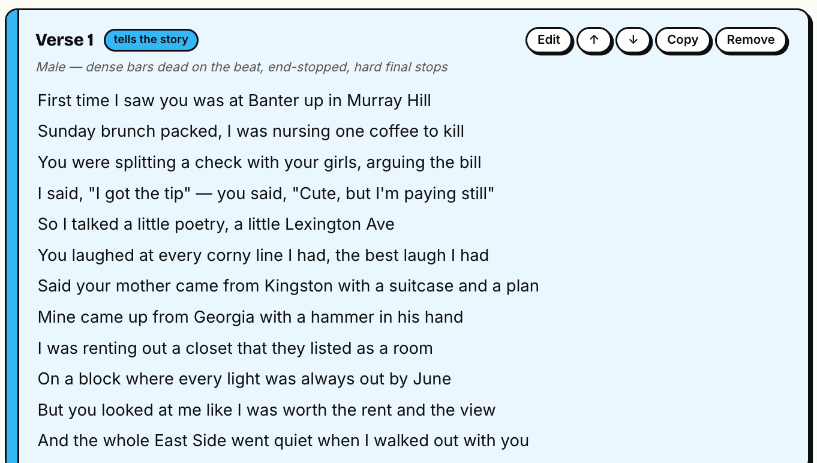
The hook became “Meet me on the High Line when the sun goes down.” And by the third verse they bring their daughter back to Banter every birthday, “still the same booth.” I didn’t write that line, or ask for it. HookGenius did.
4. Notice what stayed the same
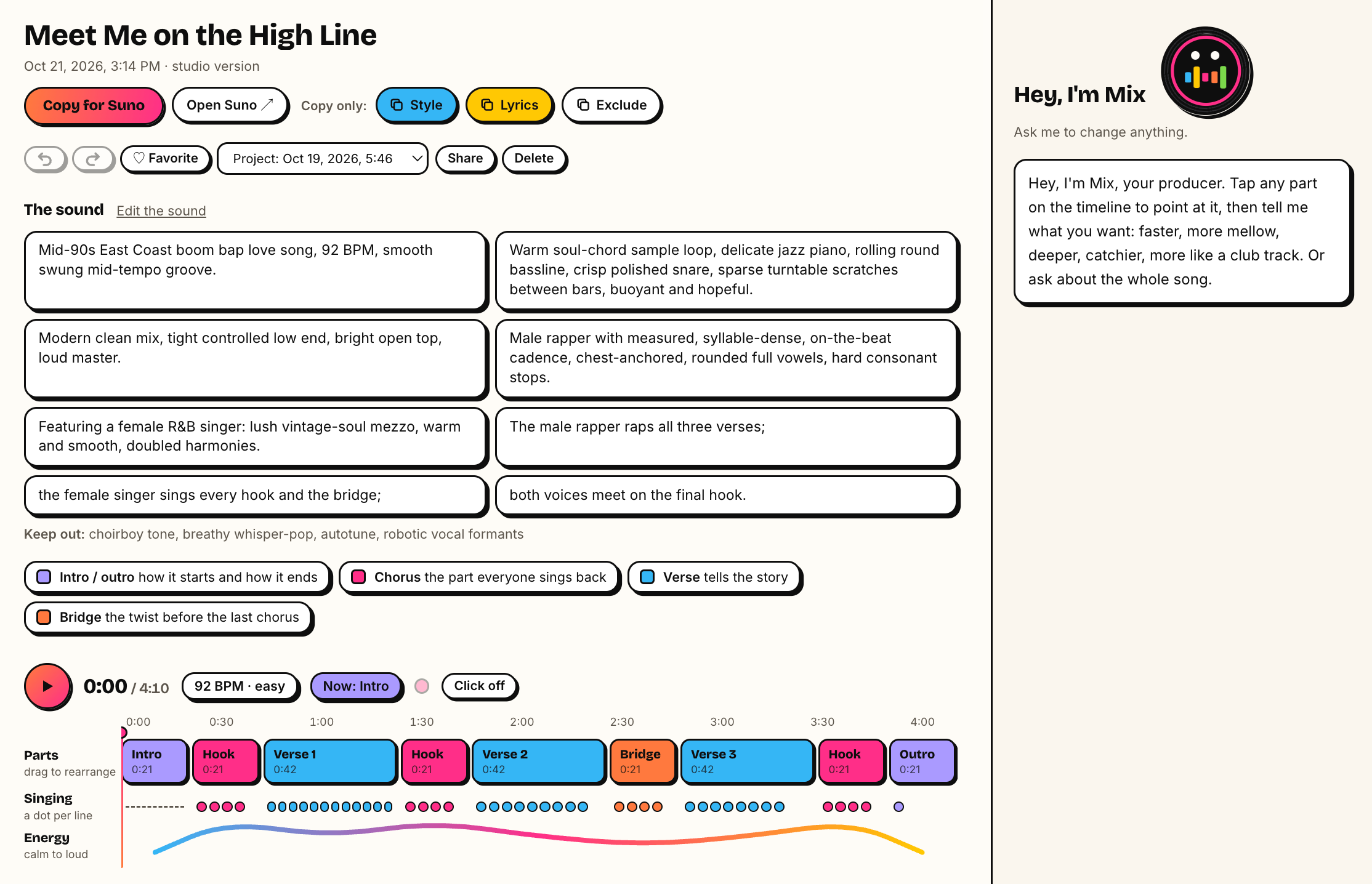
Look at what came back besides the words: the sound, written out card by card. A cast: a rapper on every verse, a singer on every hook, both on the last one. A direction on every part, like “dense bars dead on the beat, end-stopped, hard final stops.” A timeline of the whole song. That’s the production team’s work, and it’s what Suno reads to make the record sound like a record.
And when I changed the story, all of that stayed: same boom bap, same soul-chord loop, same voices. You shouldn’t have to start over to fix the part that isn’t you.
5. Copy it for Suno
One tap on Copy for Suno copies the whole song, the words and every direction, ready to paste into Suno or your AI music app. Suno sings it.
The whole trick
Two things, together. The names only you know: the brunch spot, the bench, the street you walked home on. And a system that knows how a song gets made.
You bring the life. HookGenius brings the whole production team. That’s how a song sounds like yours instead of a playlist.
Try it on your own song
Give it one word, or as much context as you have. Mix does the rest.
Open the HookGenius Studio