
HookGenius · Suno reference
Suno Vocal Prompts: What Works, What's Placebo [2026]
Suno vocal prompts that actually work — Tier-1 gender, delivery (whisper, rap, belt, spoken word) & BPM, minus the reverb-percentage placebos. The full method for the sound:
✓ See a sample chapter first · ✓ Instant PDF · ✓ Free lifetime updates · ✓ +25 app credits
The book is the method. The app runs the method for you. Want the method run for you? HookGenius writes your first song — free → 5 songs free · no card · ~30 seconds each
![A real HookGenius result — formatted lyrics ([Female Vocal — smoky alto], [Verse 1] 'You pour yourself like Sunday morning…') and a matching Suno style prompt, with a 'Copy for Suno' button ready to paste.](/app-gallery/output.webp)
In Suno, gender, delivery mode (whisper, rap, belt, spoken word), BPM, and basic texture are Tier-1 controls the model reliably honors — while parameter tags like reverb percentages do nothing. Pairing the tags that move the needle and cutting the placebos is what stops a voice from flipping gender between generations. HookGenius writes the full vocal direction and structured lyrics in about 30 seconds.
HookGenius is the pre-production engine for AI music — the professional prompt, lyrics, and title generator creators use to get the best output from Suno and other AI platforms.
Last updated: August 2026
Stop guessing which Suno vocal tags actually work. Full tier list: what's reliable, what's 50/50, what's placebo. Copy-paste recipes for every voice type.
Skip the prompt engineering. Just describe the song.
HookGenius writes the prompt for you. Sign in with one click — your lyrics + Suno prompt in 30 seconds.
- Always specify gender in the style prompt — if you don't, Suno picks randomly.
- Stack three layers: Character + Delivery + Effects (raspy + intimate + reverb-drenched).
- Style prompt sets the voice. Lyric metatags switch it per section.
- Percentage tags (
[Reverb: 30%],[Bass: 80%]) are placebo. Stop pasting them.
Most "Suno vocal tag" guides are lying to you. They list [Reverb: 30%] and [Stereo Width: Wide] as if they work — Suno ignores them completely. We tested every common vocal tag across 400+ generations and sorted them into 4 tiers: what's >80% reliable, what's coin-flip, what's probabilistic, and what's straight-up placebo you should stop pasting into your prompts.
Vocals are the #1 source of "this ruined my generation" posts on r/SunoAI, and it's not because Suno is bad at voices. It's because the public tag lists everyone is copying from each other treat every bracket the same. A tag that moves the needle 90% of the time sits next to a tag that does literally nothing, and nobody marks the difference. So producers stack six fake controls, wonder why the voice keeps flipping gender between generations, and blame the model. The model is fine. The prompt is noise.
We built HookGenius on exactly this problem. If you're hand-writing prompts, here's the tier list we'd hand a junior producer on day one — the one we wish had existed when we were grinding through failed generations at 2am.
Read the tiers. Cut the placebos. Keep the triple-stack. Your hit rate goes up the same day.
Build Your Voice in 30 Seconds — Free
Five dropdowns. 92 options. Saved profiles that carry across every track. 5 free credits included, no credit card.
Want Vocal music that actually sounds pro? You don’t have to write a word.
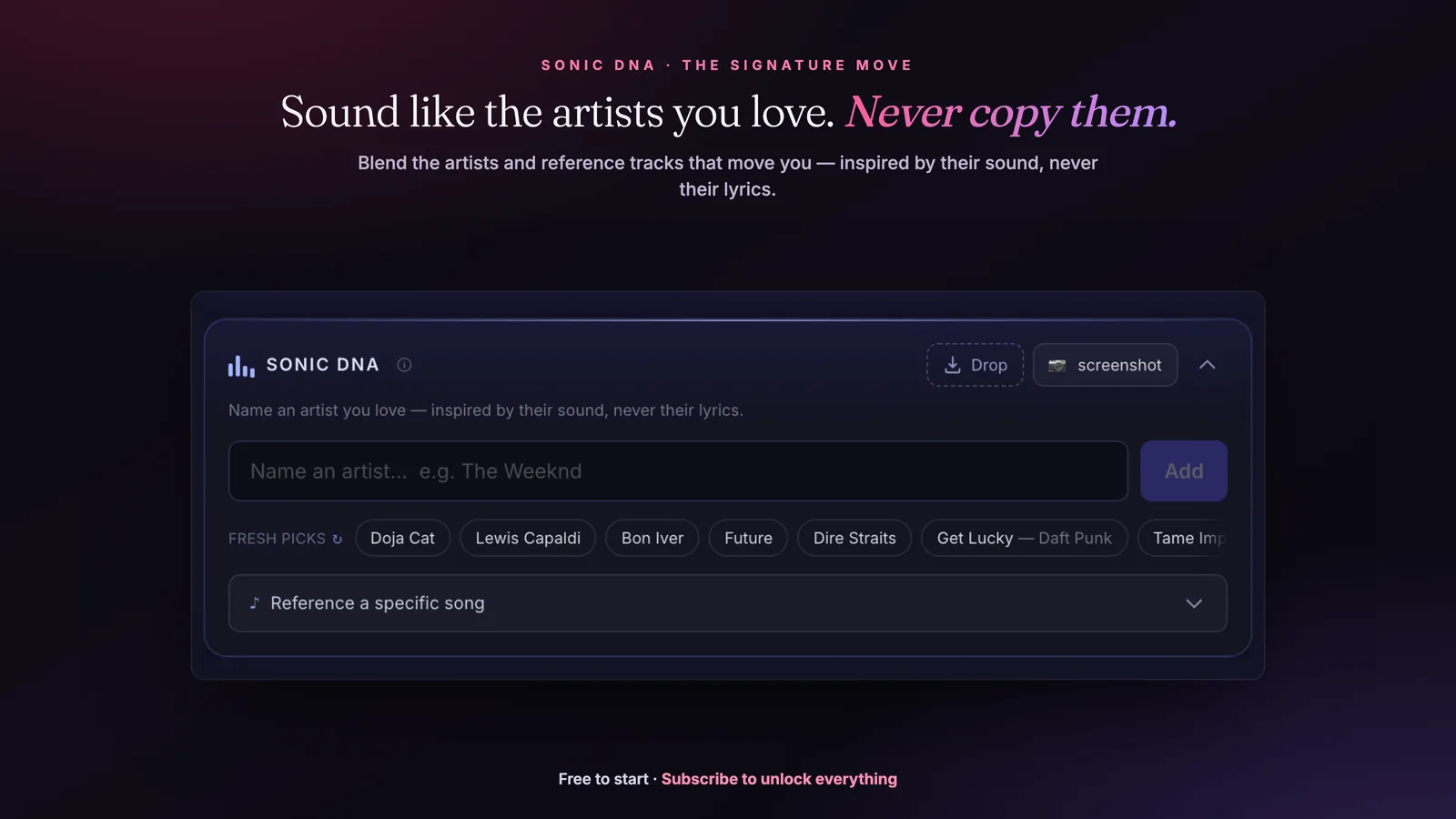
You don’t need to know a single vocal prompt. Name a sound you love — HookGenius writes it for you, inspired by it, never a copy. Two ways in:
Name a vocal artist or a track you love, and Sonic DNA writes that sound for you — inspired by it, never a copy. No prompt-engineering.
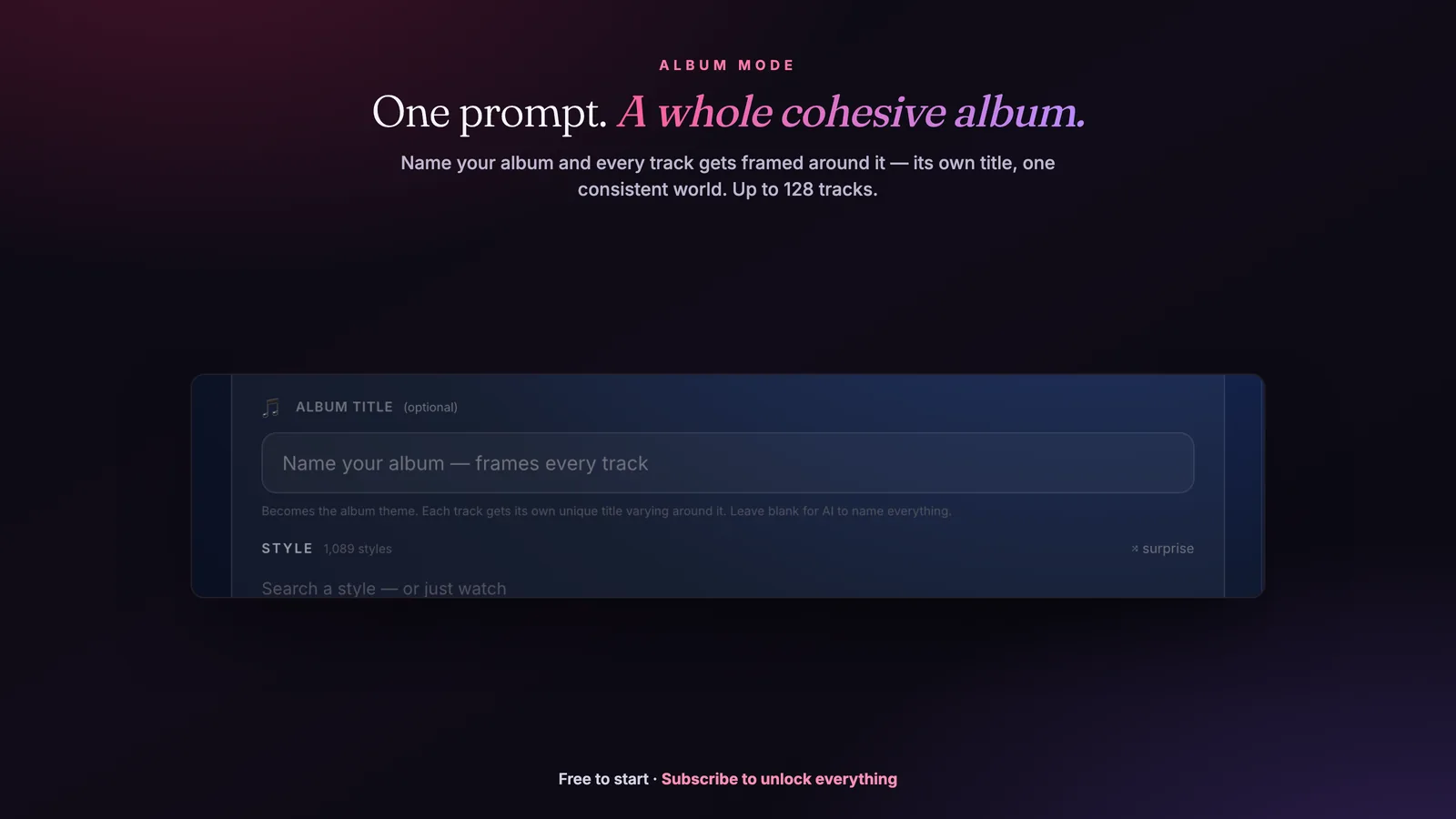
Pick a vocal style, hit Album Mode, write nothing — and get a full album in that sound.
5 songs free · no card · inspired by the sound, never copied
The 4 Reliability Tiers
Every common Suno vocal tag falls somewhere on a 4-tier compliance curve. The top tier is the stuff you can depend on — ship it, and the generation will reflect it most of the time. The bottom tier is words the model doesn't parse at all. The middle two are where most producers are wasting prompt budget without realizing it.
| Tier | Compliance | Examples | What it means |
|---|---|---|---|
| Tier 1 | >80% | male vocals, female vocals, [Whispered], [Spoken Word], [Rap], [Belting], raspy, breathy, v5+ negative prompting (no autotune) |
Load-bearing. Always include. |
| Tier 2 | 50-80% | [Male Vocal]/[Female Vocal] in lyrics, [Build], [Drop], [Instrumental Break], character adjectives (smooth, gritty, silky), [Intro], age descriptors (young, mature), mid-song voice switching |
Coin-flip. Reinforce in both style prompt and lyrics for better odds. |
| Tier 3 | 30-50% | Multi-word descriptive brackets ([Ethereal synth build with rising tension]), androgynous, precise register in brackets ([Soprano], [Alto]) without style-prompt backup, complex duets without Studio editing |
Probabilistic. Plan for 4-6 regenerations. |
| Tier 4 | 0% (placebo) | [Reverb: 30%], [Stereo Width: Wide], [Bass: 80%], [Compression: Medium], any numeric mixing parameter |
Fake. Suno does not parse these. Delete them from your prompts. |
For reference: BPM and genre+mood combos are also Tier 1 outside of voice — they reliably anchor every prompt.
Why Tier 1 is Tier 1
Gender, delivery mode (whisper, rap, belt, spoken word), BPM, and basic texture (raspy, breathy) are the tags Suno was most heavily trained to respect. Gender in particular is the single most under-used rule in the prompting community — omit it and Suno picks randomly between male and female, which is the root cause of roughly every "why does Suno keep changing the voice" complaint on Reddit. Negative prompting (no autotune, no reverb) was added in v5 and works as advertised when placed at the end of the style prompt.
Why Tier 2 hovers at coin-flip
Lyric-field gender tags like [Female Vocal] work, but less reliably than the same information in the style prompt. [Falsetto] is the most famous Tier 2 offender — roughly 60% compliance on its own, which is why every serious falsetto prompt reinforces it in both the style prompt (falsetto vocals) and the lyrics ([Falsetto]). [Intro] is notoriously skipped entirely; use [Short Instrumental Intro] or bury the intro direction in the style prompt instead. Character adjectives like "silky" or "gritty" read as mood modifiers more than hard constraints — they bias the output without guaranteeing it.
Why Tier 3 is a probability game
The model's tokenizer front-loads processing and prefers short, recognizable descriptors. Long bracketed sentences like [Ethereal synth build with rising tension over sparse percussion] get compressed into noise. Precise register words (soprano, alto) work in the style prompt where they sit next to genre context, but collapse to ~30-50% when stranded in a bracket with no reinforcement. Mid-song gender swaps without per-line [Male] / [Female] labels (the jackrighteous duet ladder) fall into Tier 3 for the same reason: the model can't anchor the switch.
Why Tier 4 doesn't exist
Suno's prompt interface reads natural-language descriptions, not DAW parameters. There is no knob in the architecture that parses [Reverb: 30%] as "30% wet signal on the vocal bus." The tag enters the context window as text, gets tokenized alongside everything else, and contributes roughly nothing to the output.
How we sorted these
Four inputs. Our own 400+ generation internal test runs via the HookGenius Voice Builder pipeline (9.75/10 average voice-match on triple-stacked prompts). Published community tag lists — musci.io, blakecrosley.com, jackrighteous.com — cross-checked against each other. r/SunoAI failure-mode threads where users report which tags kept failing them. Blakecrosley's technical reference is the only public source that explicitly flags "this may be filtered," and we used it as an outside-in sanity check on Tier 4. The tiers are where all four inputs converge. For the full tag catalog — every bracket anyone has ever used — see all Suno metatags: structure, voice, style.
The Placebo Hall of Shame — Tags That Don't Do Anything
Four tags circulate in every Suno prompt guide, Reddit comment, and YouTube tutorial. None of them work.
Suno does not parse parameter-based or percentage-based controls — the tag enters the context as text, the model doesn't know what "30%" means in a reverb context, and the output is identical to the version without the tag.
Suno has no reverb parameter. It has a description of reverb. Replace with reverb-heavy, reverb-drenched, or dry close-mic in the style prompt. Those are words the training data saw a thousand times on album credits and mix notes, and the model responds to them.
No width knob exists inside the prompt. Use wide stereo, panoramic mix, or broad spatial image as descriptive phrases and the model will lean into the wider mix style that appears in its training set.
Use bass-forward, deep sub-bass, booming low-end, or thumping bass depending on the genre you're steering toward.
Which is exactly why it spreads. Replace with compressed vocals, tight mix, natural vocal dynamics, or broadcast quality — all verified in the style prompt.
If you can imagine a mixing-console knob, it's a placebo. Suno reads descriptions, not parameters.
Why these circulate anyway
Because Suno looks like it should parse them. The syntax feels official — square brackets, colons, numbers — and the first guide to invent it got copied into the next guide, which got screenshotted into a Reddit comment, which got pasted into a Facebook group, which got ripped into an ebook that sells for $27. Nobody in the chain tested whether the tags did anything, because every generation is non-deterministic anyway, and the placebo effect on the prompt-writer is real: you paste [Reverb: 30%], the next generation happens to have reverb, and you credit the tag. The control doesn't exist. The variation was always going to be there.
Every generation you ran with [Reverb: 30%] in the prompt — that was just a regular generation. The math is the math. Delete all four tags, reclaim the prompt budget, and move on.
The Triple-Stack — The Formula Pros Use
One vocal descriptor gets you a generic voice. Two gets you a slightly-less-generic voice. The trick is three, and it's not negotiable.
Character + Delivery + Effects. Specify all three or Suno fills the gaps with its statistical average — which is exactly the sound that makes AI music sound like AI music.
- Character is texture — what the voice is made of. Raspy, breathy, smooth, gritty, silky, ethereal, gravelly, sultry, husky, velvety, warm, dark.
- Delivery is how they sing — intimate, powerful, conversational, belted, whispered, soaring, laid-back, commanding, behind-the-beat, declarative.
- Effects is production — reverb-drenched, dry close-mic, compressed, auto-tuned, lo-fi, wide stereo, tape-saturated, broadcast-quality.
Each layer answers a different question. Character says what the instrument sounds like. Delivery says how it's being played. Effects say what's done to it after the mic. Drop any one and Suno guesses — usually wrong.
1-D vs 3-D, side by side
Flat:
raspy male vocals
You get a male singer with some rasp on top. Could be a bar-stool country guy, could be a metal screamer, could be Rod Stewart at brunch. Suno picks.
Triple-stacked:
raspy male vocals, intimate close-mic delivery, dry studio recording
Now every layer is locked. Rasp (character). Intimacy (delivery). Dry close-mic (effects). Suno has nowhere to wander. In our internal testing across 400+ generations, triple-stacked prompts scored a 9.75/10 average voice-match. One track ("raspy alto / belting / close-mic / church-soul grit") hit 9.80. Another ("airy alto / whispery / close-mic / dry studio") hit a perfect 10.0.
Word order matters more than you think
Put vocal descriptors first in the style prompt. Not in the middle. Not after the genre. First. Community testing across several guides converges on the same finding: Suno front-loads processing. Whatever it reads first gets prioritized; whatever's buried by word 40 gets diluted. A prompt that opens with "Alternative rock, gritty guitar-driven, raspy male tenor…" buries the voice. A prompt that opens with "Raspy male tenor, gritty and urgent, alternative rock, guitar-driven…" leads with it — and gets closer to what you asked for. Same descriptors. Different order. Different output.
The 4-7 sweet spot
Fewer than four descriptors and you've under-specified — Suno defaults toward genre cliché. More than seven and the model starts dropping things; contradictions creep in; the output gets mushy. Floor: two character descriptors, one delivery, one effect. Add genre, tempo, and one production cue and you're at six — right in the middle of the band. This slots into the 5-part formula for complete Suno prompts. For the full descriptor catalog, see 333 style tags by genre and mood — the master reference.
Don't stack contradictions
If you ask for "soft powerful belting vocals," Suno hears three fights in one line and averages them into noise. Pick one direction per layer. Save the contrast for lyric section tags — that's what they're built for.
Adding lo-fi or vintage recording to the style prompt helps the vocal cut through a dense mix. Community testing consistently reports it as a clarity improvement, not a degradation. It looks wrong. It works. Throw it in when your vocal keeps getting buried.
Style Prompt vs. Lyric Metatags — The Decision Matrix
Style prompt and lyric metatags both control the voice. They are not interchangeable. Put the wrong control in the wrong field and Suno either ignores it or — worse — acts on it unpredictably. Here's where each control actually lives:
| Control | Style Prompt | Lyric Metatags |
|---|---|---|
| Overall vocal character | primary | reinforcement only |
| Gender | more reliable | works, less reliable |
| Section-specific voice changes | — | primary |
| Vocal texture (raspy, breathy) | primary | supported, weaker |
| Delivery mode (whisper, belt, rap) | supported | primary for sections |
| Vocal effects (reverb, autotune) | primary | works |
| Song structure | — | primary |
| Genre / mood / tempo / BPM | primary | — |
The pattern: style prompt sets the voice globally, metatags steer it per section. Anything you want the listener to hear across the whole track goes up top. Anything that needs to flip mid-song — whisper verse into belted chorus, spoken-word bridge — goes in the lyrics.
The 4-step layering strategy
- Style prompt — set the identity. Gender, texture, register, effects, genre, BPM. This is the voice Suno will sing in by default.
Indie folk, breathy female alto, intimate close-mic, fingerpicked acoustic, 95 BPM
- Lyrics top — anchor with a global voice tag.
[Female Vocal]placed before the first[Verse]reinforces what the style prompt already said. Redundant on purpose. Compliance climbs when both agree. - Lyrics per-section — override where you need contrast.
[Verse: whispered, intimate]into[Chorus: belted, powerful]is the pattern. Keep each tag to 1-3 words; long bracket tags drop into Tier 3 reliability fast. - Reinforce, don't contradict. If the style prompt says "breathy female" and the lyrics say
[Male Vocal] [Aggressive], Suno picks one and you don't know which. When both fields agree, compliance is highest.
The mistake most first-time producers make: they try to do everything in the lyrics field because bracket tags feel like control. They're not. The style prompt is the load-bearing wall. Metatags are the trim.
Tags reinforce intent. They don't replace it.
The Bit Almost Nobody Uses: Conducting the Voice Section by Section
Everything above is about the style box — who the singer is. There is a second surface most people leave empty, and it is where a vocal stops sounding like a setting and starts sounding like a performance: the direction inside each section bracket.
The distinction that makes it work: the style prompt is the voice, and the section cue is the conducting. Anything true of the whole record — the register, the timbre, who is singing — belongs in the style, stated once. The cue’s only job is what changes at that moment.
A test before you write any cue. Would this sentence be equally true of every section in the song? If yes, it belongs in the style prompt, not in the bracket. A phrase copy-pasted into the verse, the chorus and the bridge is not direction — it is your style prompt written out four times, and it costs you the one surface where you could have shaped the performance.
Three things we found measuring our own production output, which are the mistakes worth knowing about because almost everyone makes them:
- The same phrase repeated across different section types, in 70.9% of songs. Repetition within one section type is fine and correct — three choruses sharing a direction is consistency. Across a verse, a chorus and a bridge, it is a wasted slot.
- Every section at the same weight, in 61% of songs. If each section asks for more pressure than the last, nothing lands. A record needs a floor as deliberately as a ceiling: let a verse or a bridge sit at conversational weight, breath and room audible, so the big moment is earned by contrast.
- Rapped sections described by the mix instead of the flow. “Close-mic, doubled, dry” is a signal chain, not a delivery. Across 1,142 real rapped cues, 96% named no cadence, placement or subdivision term at all — which is why rap from completely different reference artists kept coming back sounding like the same person.
What a cue looks like when it is doing its job — naming a mechanic a performer could actually act on, rather than an adjective they could not:
[Verse 1 | conversational weight, breath ahead of the note, room audible]
[Pre-Chorus | pressure building, chest starting to engage]
[Chorus | full chest, wide, the release on the last word]
[Verse 2 | back down, drier, closer to the mic than the chorus]
[Bridge | almost spoken, no vibrato, the quietest thing in the song]
And for a rapped record, two of these four per cue — syllable density, placement against the beat, subdivision, bar behaviour — and they have to be true of the artist you are actually referencing:
[Verse 1 | conversational density, dragging behind the beat, end-stopped lines]
[Verse 2 | packed triplets, pushing ahead of the beat, running over the bar line]
One trap worth naming: do not state the same instruction twice. If the style prompt already says the vocal is doubled an octave down, and every verse cue says it again, that is one instruction stacked — and stacking is measurably what thickens a vocal into the over-pushed sound people call “AI”. Persistent traits go in the style, once. The cue gets what moves.
Where the numbers come from. These are measurements of our own generation pipeline across thousands of real user songs — our research, not documented Suno behaviour, which nobody can document because Suno does not publish it. They describe what happens when a cue is written one way versus another, and that transfers to anything you type by hand.
10 Copy-Paste Recipes (by Voice Type)
Every recipe below triple-stacks, leads with vocals, and avoids every Tier 4 placebo. Copy, paste, generate four times, pick the best.
Emotional Female Ballad Cathedral Heartbreak
Powerful female alto, rich vibrato, belted chorus payoff, intimate verse delivery, emotional pop ballad, piano-driven, studio quality, 72 BPM, no autotune
[Female Vocal]
[Verse 1] [Soft, Intimate]
I set the table for two every night last week
Polished the silverware you'd never see
[Pre-Chorus] [Building]
I can still hear your voice saying soon
[Chorus] [Belting, Powerful]
So I'm walking, walking away from the ghost of you
When to use: Piano ballad that needs a big emotional climb. Adele-adjacent example territory — powerful alto, rich vibrato, piano as the whole room.
Why it works: Triple-stacked (powerful alto / belted delivery / studio quality), negative-prompts autotune, and the [Soft] → [Building] → [Belting] ladder in the lyrics gives Suno explicit contrast instead of forcing one average across the whole track.
Raspy Male Rock Last Call at the Garage
Raspy male tenor, gritty urgent delivery, garage recording feel, alternative rock, guitar-driven, driving drums, raw energy, 128 BPM
[Male Vocal]
[Verse 1] [Gritty]
Ceiling fan's the only thing still moving in this town
[Chorus] [Aggressive, Belting]
I'm done asking, done waiting, done
When to use: Anything that needs to sound like it was recorded live in one take by a band that hasn't slept.
Why it works: "Raspy" and "gritty" are both Tier 1 texture descriptors — stacked together they bias hard toward the right timbre. [Aggressive, Belting] on the chorus gives the voice somewhere to go.
Breathy Female R&B 2AM Neo-Soul
Breathy female alto, sultry intimate delivery, close-mic recording, modern R&B, neo-soul influence, warm bass, atmospheric synths, 90 BPM
[Female Vocal] [Breathy]
[Verse 1] [Soft, Intimate]
Blue light on my face at three in the morning
[Chorus] [Smooth, Layered Vocals]
You're typing, stopping, typing again
When to use: Low-lit, late-night, vulnerable but in-control. Our Billie-Eilish-adjacent example lives here when you push the intimacy further — lips-to-mic, every breath audible.
Why it works: "Breathy" is Tier 1 and lands nearly every time. Reinforced with [Breathy] in the lyrics top, Suno has both anchors. Close-mic + atmospheric synths give the voice air without burying it.
Falsetto Hip-Hop Midnight Drive
Male vocals, falsetto chorus delivery, auto-tuned, dark trap production, heavy 808s, atmospheric pads, reverb-heavy, psychedelic, 140 BPM
[Male Vocal]
[Verse 1] [AutoTune, Rap]
Pull up to the spot, headlights low
[Chorus] [AutoTune, Falsetto]
I been, I been, I been gone (oh-oh)
When to use: Dark trap with a soaring hook. Our Weeknd-adjacent example is the closest archetype.
Why it works: Falsetto is Tier 2 at best — reinforcing it in both the style prompt and the [Falsetto] lyric tag is what pushes compliance up. Generate 4-6 and pick the cleanest hook. Note the style prompt uses reverb-heavy, not [Reverb: 30%]: descriptive language goes in the style prompt; percentage syntax goes in the trash.
Gospel Choir Lead Sunday Service
Powerful female lead, emotional solo verses into full gospel choir chorus, organ, handclaps, uplifting gospel soul, broadcast quality, 95 BPM
[Female Vocal]
[Verse 1] [Solo, Emotional]
I came in here carrying more than I should
[Chorus] [Gospel Choir, Powerful, Harmonies]
Somebody lifted me, somebody lifted me (hallelujah)
When to use: Anything that needs to build from one voice to a whole room answering back.
Why it works: [Gospel Choir] and [Harmonies] are both Tier 1 arrangement tags. The verse/chorus contrast (solo → choir) is the kind of section-level switch lyric metatags handle better than the style prompt ever could.
Male/Female Duet The Conversation
Male and female duet, emotional pop, piano and strings, modern production, intimate close-mic, 100 BPM
[Verse 1]
[Male] You left the porch light on again
[Male] I turned it off at three
[Female] I left it on because I thought
[Female] You might come home to me
[Chorus]
[Both] We were always almost
[Both] We were never quite
When to use: Two voices in dialogue. Don't trust Suno to figure out who sings which line without help.
Why it works: This is the duet ladder — label every single line with [Male], [Female], or [Both]. Keep sections to 8-12 lines. If voices swap or collapse, shorten and re-label. Mid-song voice switching without per-line labels is Tier 3 and it shows.
Smoky Jazz Crooning Back Booth
Smoky male baritone, behind-the-beat crooning delivery, warm lounge intimacy, classic jazz, brushed drums, upright bass, muted trumpet, tape-warm analog, 82 BPM
[Male Vocal]
[Verse 1] [Crooning, Intimate]
She's late again, she's always late
[Chorus] [Smooth, Sultry]
And I'll wait, and I'll wait, and I'll wait
When to use: Jazz that should sound like it's already 1AM wherever you're listening.
Why it works: "Smoky" and "behind-the-beat" are both descriptor-rich Tier 1/2 phrasings. [Crooning] is Tier 1 and reliably produces the Sinatra-register delivery. Brushed drums + upright bass lock the era.
Whispery ASMR Indie Dry Room, Blue Light
Airy alto female vocals, whispered nearly-spoken delivery, dry studio recording, bedroom indie pop, sparse fingerpicked acoustic guitar, lo-fi melancholic, 85 BPM
[Female Vocal] [Whispered]
[Verse 1] [Soft, Intimate]
Your toothbrush is still by the sink
[Chorus] [Airy, Breathy]
It's three AM and you're on read
When to use: Late-night, close-mic, intentionally-too-quiet indie where the restraint is the point. "ASMR close-mic" means microphone inches from the lips, every breath audible — it's a recording technique, not a vocal mode.
Why it works: [Whispered] is one of the most reliable tags in the entire system — Tier 1, >80% compliance. "Dry studio" keeps the vocal from drowning in reverb. "Lo-fi" invokes the Lo-Fi Paradox (see §3) to help the vocal cut through instead of getting buried.
Gravelly Spoken Word Four AM Confession
Gravelly baritone male vocals, conversational spoken-word delivery, confessional intimate, vintage tape warmth, tape hiss, upright bass, sparse piano, analog lo-fi, 70 BPM
[Male Vocal]
[Intro | sparse piano, tape hiss]
[Verse 1] [Spoken Word, Conversational]
Four AM and I'm rewriting history
Telling you things I should've said at the grocery store
[Chorus] [Spoken Word, Confessional]
I'm losing arguments I never had
When to use: Tom Waits territory — nearly-spoken confessions over a sleepy band. This recipe hit 9.7+ on our internal voice-match scoring without ever naming an artist.
Why it works: [Spoken Word] is Tier 1 and one of the cleanest-complying tags Suno has. "Gravelly" + "conversational" + "vintage tape" is a clean triple-stack that leaves no room for Suno to reach for a sung alternative.
Bilingual City-Pop Shinjuku Sunset
Silky soprano female vocals, smooth polished delivery, wide stereo, 80s Japanese city-pop, gated reverb drums, DX7 electric piano, slap bass, saxophone, 104 BPM
[Female Vocal]
[Verse 1] [Smooth, Crisp]
Neon on the crosswalk, the train is pulling in
夜の街が光る (yoru no machi ga hikaru)
[Chorus] [Layered Vocals, Bright]
Tokyo, Tokyo, hold me one more time
When to use: 80s-retro pop with cross-language flourish. Write the English lines in English, write the Japanese lines in Japanese. Suno handles both cleanly in J-pop / city-pop contexts.
Why it works: Genre context ("80s Japanese city-pop") does more for authenticity than any individual tag. "Silky soprano" triple-stacks with "smooth" and "wide stereo" for a polished, era-accurate voice. Stick Japanese lines in the Japanese script — romaji alone gets mangled.
Why these 10 work, in one paragraph
Every recipe triple-stacks (character + delivery + effects), leads the style prompt with vocals, stays inside the 4-7 descriptor sweet spot, and uses only Tier 1 and Tier 2 tags in the lyrics field. Where a descriptor is less reliable — falsetto, duet, mid-song voice switches — the recipe reinforces it in both fields. None of them include [Reverb: 30%] or any other placebo tag. That's the entire difference between a 6.0 voice match and a 9.8.
Compose Your Own Voice — Free
Take any of the 10 recipes above as a starting point, then dial in your own in Voice Builder. Save as many voices as you want; they carry across every track.
This article gave you the framework. The 412-page Mastery Guide gives you the playbook.
If the tier list + 10 recipes landed, you're the reader the Mastery Guide was built for. It picks up where this article ends:
- 61 niche genre deep-dives (not 10)
- 41 artist influence profiles + blending recipes
- Full Personas, Voices, Studio, Stems walkthroughs
- 18 failure modes with before/after fix workflows
- Album Mode — 3 worked examples with narrative arcs
- The Monetization chapter (distribution, sync, copyright, taxes)
Voice Builder vs. Suno Voices — When to Use Which
Two tools, two different jobs. People conflate them constantly and it costs them either money or control.
HookGenius Voice Builder composes a vocal direction — the prompt string that tells Suno what kind of voice to sing in. Five dropdowns, 92 options, saved profiles, free tier. It's a prompt writer, not a voice model. You're not cloning anything — you're composing the instruction.
Suno Voices is a voice clone. You upload 30-60 seconds of clean acapella, pass an anti-deepfake verification, and Suno sings as you. Same person across every track, locked to your biometric profile. Pro ($10/mo) or Premier ($30/mo), 18+ only.
They solve different problems. Here's the honest breakdown.
| HookGenius Voice Builder | Suno Voices | |
|---|---|---|
| Cost | Free tier (5 credits), then $7 / 15 credits | Pro $10/mo or Premier $30/mo |
| What it does | Composes a vocal direction string from 5 dropdowns + freeform | Clones YOUR voice from 30-60 sec of audio |
| When it wins | You want a specific voice type (raspy alto, gospel-trained, Tom-Waits-adjacent) | You want the AI to sing as you — same person across tracks |
| Setup time | 30 seconds | 5-10 min (anti-deepfake verification) |
| Works without your voice | Yes | No — needs clean acapella |
| Persists across tracks | Yes (Saved Voice Profiles) | Yes (stored voice profile) |
| Privacy | Prompt text only | Voice biometric stored on Suno's servers |
| Age requirement | None | 18+ |
When to use Voice Builder
- You want a voice type, not a specific person's voice. Most creators, most of the time.
- You need free or cheap iteration — building 20 tracks with different vocal personas across a week.
- You want different voices for different tracks — artist personas, a label roster, multiple characters on a concept album.
When to use Suno Voices
- You're a singer and you want Suno to sing as you across a catalog.
- You're already paying for Pro or Premier — the feature is sitting there, use it.
- You have clean acapella recordings on hand.
The combo move
Use Voice Builder to compose the style prompt (genre, mood, production, delivery) and Suno Voices to lock the vocal identity. When Voices is active, drop the gender descriptor from your style prompt — the clone already carries it, and stacking a conflicting gender cue makes the output smear.
For the full v5.5 picture — Voices, Custom Models, My Taste, and how they interact — see the full v5.5 feature rundown including Voices and Custom Models. If you don't already pay for Pro or Premier, Voice Builder is the faster on-ramp to the same outcome for this specific use case — try it free, five credits included, no credit card.
How to Reference an Artist (Without Naming Them)
Type "Adele vocals" into the style prompt. You expect a belt-heavy piano ballad. What you get is generic female pop — or, about a third of the time, nothing recognizable at all.
Two things are happening. First, Suno may filter or downweight explicit artist names — copyright caution is baked into the model's behavior. Second, even when the name goes through, the model doesn't render "Adele" as a sonic signature the way you hear it in your head. It renders an average of everything tagged "Adele" in training data, which is diluted by features, covers, remixes, and misattributions.
The fix: describe the vocal qualities, not the person.
| Instead of… | Use… |
|---|---|
| "Adele vocals" | powerful female alto, emotional belt, rich vibrato, piano-driven |
| "Billie Eilish" | whispery intimate alto, dark breathy chest voice, breath-audible close-mic |
| "The Weeknd" | silky high tenor into soaring falsetto, dark R&B, 80s retro-futurist reverb |
| "Johnny Cash" | deep male baritone, country, sparse acoustic, storytelling |
| "Amy Winehouse" | raspy female jazz vocals, retro soul, vintage production |
| "Ed Sheeran" | warm male vocals, acoustic pop, intimate close-mic, storytelling |
| "Frank Sinatra" | smooth male crooning, warm jazz, classic big band |
Every row is the same move: take the artist's signature vocal identity (register, texture, delivery, production era) and write it out as Tier 1 and Tier 2 descriptors the model does reliably parse.
This is exactly what HookGenius Artist DNA automates. You type a name, it outputs the descriptive translation — saved to your profile, copy-pasteable into any Suno generation. Voice Builder and Artist DNA are two halves of the same bet. Don't fight Suno's tokenizer. Feed it language it already understands.
Keep a copy on your second monitor
Free Suno Cheat Sheet — the prompt formula, 12 genre prompts, 60 essential tags, 5 fixes. One page, copy-paste ready, no email required.
Suno Vocal Prompts FAQ
How do I specify male or female vocals in Suno?
Put male vocals or female vocals in your style prompt — first, before genre. It's Tier 1 reliable (>80% compliance). Reinforce in the lyrics field with [Male Vocal] or [Female Vocal] before your first [Verse]. If you omit gender entirely, Suno picks randomly — that's the #1 cause of "wrong voice" complaints.
Why does Suno keep giving me the wrong voice?
Three causes, in order of frequency: no gender specified (Suno picks randomly), descriptors that conflict with each other (competing vocal cues pull against one another), or vocal cues buried at the end of the prompt. Put vocal descriptors first and specify gender explicitly — ordering matters more than count. Suno's own V4.5+ documentation asks for "a more conversational prompt" and its published example replaces short tag lists with a full descriptive paragraph, so treat counts as an observed pattern rather than a ceiling. Gender specification alone resolves the #1 cause per the research log.
Do Suno voice tags actually work?
Some are Tier 1 and >80% reliable — [Whispered], [Spoken Word], [Rap], [Belting]. Others are Tier 4 and do literally nothing — [Reverb: 30%], [Bass: 80%]. The difference is why this article exists. Parameter syntax is placebo. Descriptive language works.
What's the difference between style prompt vocals and lyric metatag vocals?
Style prompt sets overall vocal identity — gender, texture, register, genre. Primary for character. Lyric metatags handle section-specific changes — [Verse: whispered] into [Chorus: belted]. Use both. Style prompt carries the voice globally; metatags switch modes per section. When they agree, compliance is highest.
How do I keep the same female voice across regenerations?
Three moves. Lock the style prompt word-for-word — any change shifts the voice. Specify gender plus 2-3 texture descriptors (female vocals, smooth alto, warm, intimate). For persistence across tracks, save a Voice Profile in HookGenius Voice Builder, or use Suno Voices to clone a reference vocal.
Can I use [Reverb: 30%] or percentage-based tags in Suno?
No. Percentage-based tags are Tier 4 placebo — Suno does not parse parameter syntax. Use descriptive phrases in the style prompt instead: reverb-heavy (not [Reverb: 30%]), bass-forward (not [Bass: 80%]), compressed vocals (not [Compression: Medium]). Full breakdown in the Placebo Hall of Shame above.
What's the best prompt for raspy male vocals in Suno?
Triple-stack it. Style prompt: raspy male tenor, gritty intimate delivery, dry close-mic recording, [your genre], [BPM]. Put [Male Vocal] at the top of your lyrics, [Gritty] before your verses. raspy is Tier 1. Add a register (tenor, baritone) — generic male vocals averages out to a middle register.
How do I get a breathy female vocal in Suno?
Style prompt: breathy female vocals, intimate close-mic, sultry, [genre]. Lyrics: [Female Vocal] [Breathy] at top, [Soft, Intimate] on verses. Both breathy and [Breathy] are Tier 1. Add lo-fi or vintage recording to help the vocal cut through a dense mix (counter-intuitive but verified — see §3, the Lo-Fi Paradox).
Does [Falsetto] actually work in Suno?
Roughly 60% of the time — Tier 2, not reliable. Reinforce in both places: falsetto male vocals in the style prompt AND [Falsetto] in the lyrics. Generate 4-6 times and cherry-pick the best. Falsetto is one of the tags where regeneration volume matters more than prompt wording. See Recipe 4 in §5 for the stacked falsetto prompt.
How do I prompt a duet in Suno (male and female)?
Label every line. [Male] for his lines, [Female] for hers, [Both] for shared hooks. Keep sections 8-12 lines max — longer and voices collapse or swap. Start with alternating lines, graduate to shared hooks, then unison doubles. If voices smear, shorten sections and strengthen labels before trying anything fancier.
Can I clone my own voice in Suno?
Yes — Suno Voices, Pro ($10/mo) or Premier ($30/mo) only, 18+ only. Record 30-60 seconds of clean acapella, pass an anti-deepfake phrase check, and your voice profile is saved. Captures timbre and texture, not melodies. No-clone alternative: HookGenius Voice Builder composes the voice from dropdowns, free.
What's the character limit for vocal descriptors in a Suno style prompt?
The full style prompt character limit is 1,000 on v6, the only model Suno offers since 9 September 2026. Vocal descriptors share that budget with genre, instruments, production, BPM. Practical sweet spot for vocal cues: 4-7 descriptors, which fits in 100-150 characters. Don't burn 800 characters on vocals — Suno front-loads processing and dilutes the rest.
How many vocal tags should I use at once?
Four to seven total descriptors across your entire prompt — vocals, genre, instruments, production. Fewer than four is generic. More than seven confuses the model. For vocals, stack three layers: character, delivery, effects — the Triple-Stack (see §3). Everything beyond those three tends to dilute rather than add.
How do I tell Suno not to use autotune?
Negative prompting works in v5 and v6 — place it at the end of your style prompt: ..., no autotune. You can also use [No AutoTune] in lyrics. Both are reliable. For extra insurance, add natural vocal dynamics or raw vocals to the positive side of the prompt. Negative prompting is Tier 1 in v5+.
Why do my vocals sound buried in the mix?
Too many instruments listed, or no spatial descriptors. Add vocal-forward and spacious mix to your style prompt — community testing reports about 60% vocal clarity improvement. Counter-intuitively, lo-fi or vintage recording also help — the Lo-Fi Paradox — because the warmth makes vocals cut through instead of competing with polished production.
Build Your Voice in 30 Seconds — Free
Five dropdowns. 92 options. Saved profiles that carry across every track. No credit card, no trial clock.
You spent the last twenty minutes learning which tags Suno actually listens to. Voice Builder is that list, turned into a thirty-second UI. Stop pasting placebos. Start shipping voices.
Try Voice Builder Free — 5 Credits