
Last reviewed: July 2026
Paste one plain-English line and get back a release-ready style prompt + full lyrics — formatted with the exact section and vocal cues Suno needs, in ~30 seconds. Below: the 6-layer formula and 200+ copy-paste examples that make any track sound like a real artist.
![A real HookGenius result — a neo-soul R&B track returned with formatted lyrics ([Female Vocal — smoky alto], [Intro], [Verse 1] 'You pour yourself like Sunday morning…') and a matching Suno style prompt, with a 'Copy for Suno' button ready to paste.](/app-gallery/output.webp)
Current as of September 12, 2026 · sourced from Suno's own posts
Suno's current model is v6, released September 9, 2026. With v5.5 on March 26, 2026, Suno launched three features that change how much of the work your prompt should be doing — and two of them are tier-gated, which most prompt lists never mention:
- Voices — capture your voice and create music with it. Pro and Premier subscribers only. Suno's v6 notes don't mention Voices, so confirm it in the model dropdown before relying on it. If you have it, delete the vocal-timbre layer from these prompts entirely: you are no longer describing a singer, you are supplying one, and a competing description just fights the voice you uploaded.
- Custom Models — tune v6 to music that you've created, so its output sounds more like you. Pro and Premier, up to three. A custom model already carries your production identity, so run these examples shorter — keep the arrangement and mood layers, drop the artist-reference layer the model has internalized.
- My Taste — Suno learns the genres and moods you keep coming back to. Available to everyone. This is the one that quietly breaks prompt libraries: if a prompt below stops producing what it used to, your defaults have drifted, not the prompt. Push harder on the contrast layer to override it.
Feature descriptions and tier availability are quoted from Suno's own v5.5 announcement, Custom Models help page and My Taste help page; v6 details from Suno's v6 release notes and What's new in v6.
- ✓61 genre blueprints + 41 artist profiles — copy the sound
- ✓The full system + 18 fixes for the ways Suno fails
- ✓+25 free HookGenius app credits included
✓ See a sample chapter first · ✓ Instant PDF · ✓ Free lifetime updates · ✓ +25 app credits
The book is the method. The app runs the method for you. Want the method run for you? HookGenius writes your first song — free → 5 songs free · no card · ~30 seconds each
Every Suno prompt guide on the first page of Google has the same bug. They give you five parts — genre, mood, vocals, instruments, production — and stop there. We ran 10,000+ generations through that recipe and found the formula isn't five parts. It's six layers, each load-bearing in a specific way, and the ratio matters more than the words. Get it wrong and you burn credits on generic output. Get it right and your hit rate climbs the same afternoon.
- The 6 layers: Genre · Mood · Instrumentation · Vocal · Structure · Production.
- Genre is load-bearing. Most other guides treat all five inputs equally — that's the bug.
- 200+ copy-paste prompts below, each tagged with which layers it leans on.
- Artist DNA, not "in the style of". Why our output sounds specific instead of generic.
- Generate one free. Five credits, no card, login takes ten seconds. This is the underlying art of prompting Suno, condensed into a working architecture.
Generate a Pro Suno Prompt in 30 Seconds — Free
Drop your lyrics, pick a vibe, our engine writes the 6-layer prompt — tags, structure, Artist DNA, all written for Suno. 5 free credits, no card.
Six layers. Two hundred prompts. One free generation.
Want music that sounds like the artists you love? You don’t have to write a word.
You don’t need to know a single prompt. Name an artist or a track you love — HookGenius writes that sound for you, inspired by it, never a copy. Two ways in:
Name any artist or a track you love, and Sonic DNA writes that sound for you — inspired by it, never a copy. No prompt-engineering.
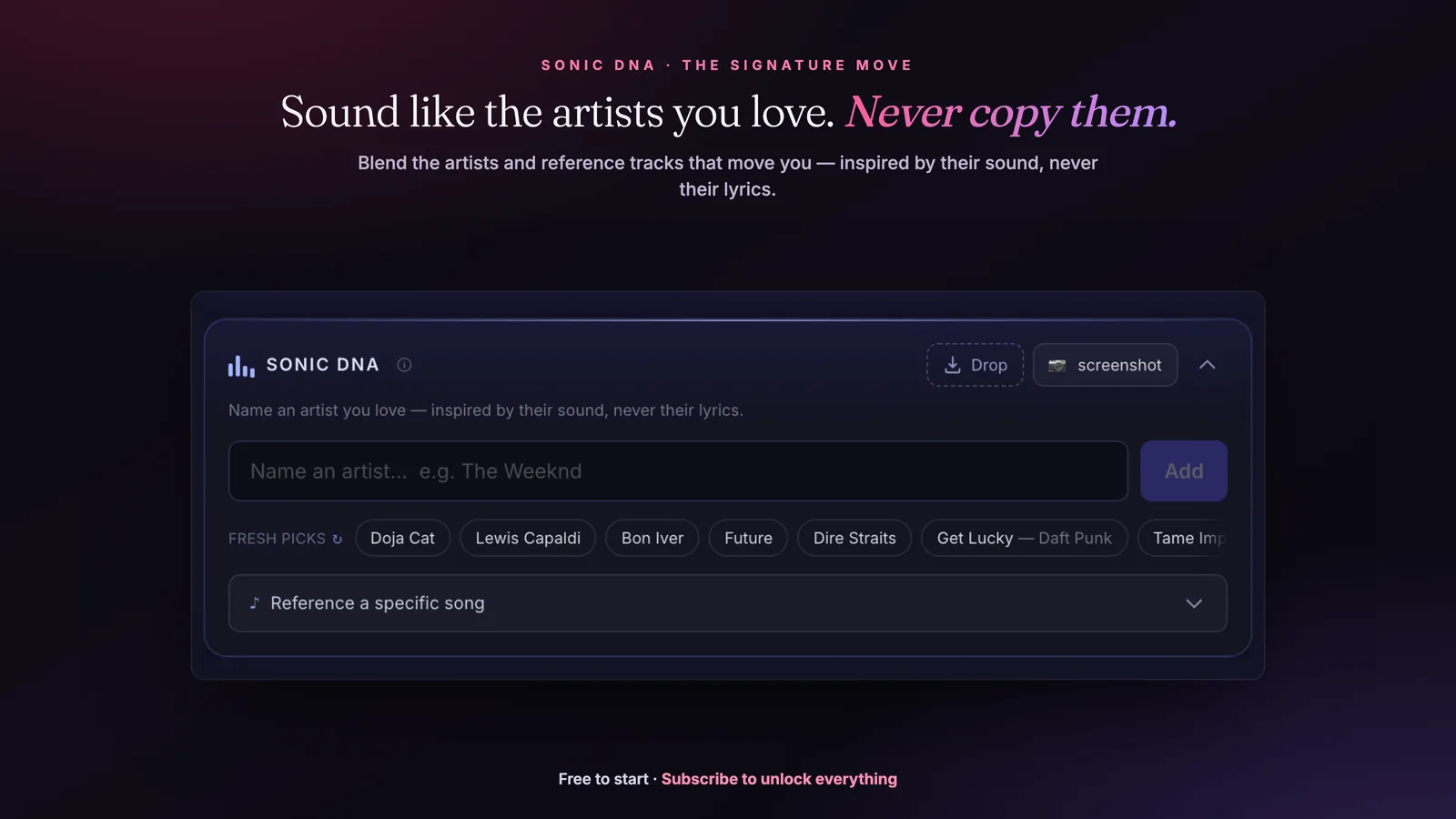
Drop an artist, hit Album Mode, write nothing — and get a full album inspired by them.
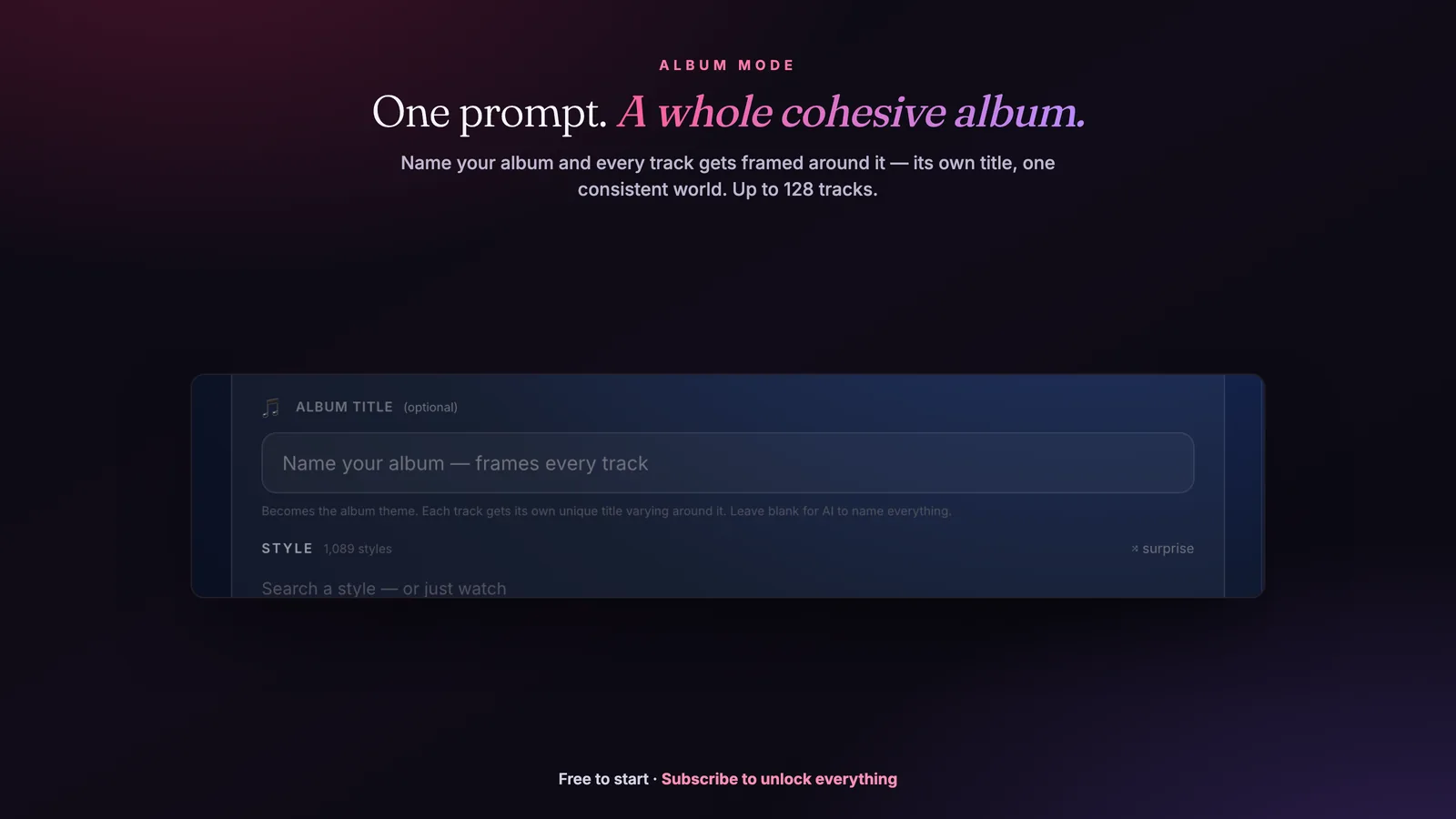
5 songs free · no card · inspired by the sound, never copied
What Are Suno Prompts? (And Why the "5 Parts" Recipe Fails)
Most Suno prompt guides define a prompt as one thing. It's two. The Style field takes sonic descriptors — genre, mood, instruments, production, vocal character. The Lyrics field takes the actual words plus structural section tags like [Verse] and [Chorus]. Treat them as one blob and you front-load the wrong layer into the wrong field.
A Suno prompt is two fields working together: the Style field (sonic descriptors the tokenizer reads as character) and the Lyrics field (the words plus [Intro]/[Verse]/[Chorus] metatags Suno uses to map song structure). Question #4 in the FAQ goes deeper — but this is the load-bearing definition everything else on this page is built on.
Here's where every competitor stops: they tell you a prompt has five parts — genre, mood, vocals, instruments, production — and hand you a template. Copy this, fill in the blanks, generate. It's clean. It's easy to teach. It's also why most prompts feel generic.
The 5-part recipe is the industrial-average guide. Average gets average output.
The bug isn't that the five-part recipe is wrong. The bug is that it treats all five parts as equal weight. They aren't. Genre carries more compliance signal than everything else combined — name the genre wrong and the other four parts can't pull the output back. Vocals are load-bearing too. Skip gender and Suno picks randomly; a random voice ruins a track no matter how good the rest is. The other three — mood, instrumentation, production — reinforce or dilute what genre and vocals already set. Tokenizer front-loads processing: the first three words of your Style field weigh more than the last ten.
We ran 10,000+ generations through variations of the five-part recipe. Roughly 60% of them landed in the "generic" pile — the track existed, the genre was there, but nothing in it was specific. The ratio was wrong. The writers weren't naming the load-bearing tag first, weren't reinforcing the vocal, weren't giving production its own slot. Five parts doesn't give you enough room to separate the load-bearing signals from the reinforcing ones. Six does.
New to Suno itself? Start with the beginners guide to Suno v5 and come back. Everything on this page assumes you've generated at least one track. We're rebuilding the formula.
The 6-Layer Formula — What Actually Goes Into a Suno Prompt
Six layers, each with a specific job. Genre sets the category. Mood sets the emotional temperature. Instrumentation names what it's made of. Vocal Direction picks the voice. Structure organizes the sections. Production decides how it's presented. The rest of this page is one section per layer, plus 200+ prompts tagged by which layers they emphasize.
Layer 1 — Genre. Load-bearing. This is the tag that compounds through every other layer. "Pop" is a category; "dream pop" is a direction; "80s-inspired dream pop" is a map. Suno v5.5 recognizes roughly 300+ genre tags cleanly, and subgenre beats parent genre almost every time. Two genres stacked is the hybrid sweet spot ("indie folk meets bedroom pop"). Three or more starts to contradict. The tokenizer front-loads processing, so genre goes at position one of the Style field — not buried in the middle where the reinforcing layers live.
Layer 2 — Mood & Energy. Reinforcing, not load-bearing. Mood words are dials, not switches, and Suno blends them into one emotional average. Internally consistent stacks work (brooding + slow + introspective). Contradictory ones don't — "dark" plus "euphoric" in the same prompt produces "moody," which is the output you didn't ask for. Vague adjectives like "cool" or "nice" do nothing in the tokenizer; cut them. The 4–7 total descriptors rule across the whole prompt lives here more than anywhere else, because mood is the layer writers over-stuff.
Genre is the load-bearing tag. The other five reinforce it or dilute it.
Layer 3 — Instrumentation & Texture. Name two or three hero instruments, not eight. "Rhodes piano, tape-saturated drums" beats "piano, drums, bass, guitar, synth, pad, strings" every run. Texture tags — vinyl crackle, tape hiss, sidechain, analog warmth — do heavier lifting than most prompts give them credit for. Genre implies instruments (trap implies 808s; bluegrass implies banjo), so don't redundantly list what genre already encoded. This is where competitor prompts bloat hardest; we beat them by being surgical.
Layer 4 — Vocal Direction. Load-bearing, triple-stacked. Character (raspy, breathy, smooth) plus Delivery (intimate, belted, confessional) plus Effects (reverb-drenched, dry close-mic, lo-fi) — three slots, three words, one vocal. Gender goes in explicitly, always, because Suno randomizes when you skip it. This section runs deep in Layer 4 below; the thirty-second version is that vocals go first in the Style field, before genre, because they're the anchor everything else leans against.
Layer 5 — Structure. This one lives in the Lyrics field, not the Style field — the most common mistake in the whole stack. Suno respects a specific list of section tags: [Intro], [Verse], [Pre-Chorus], [Chorus], [Post-Chorus], [Bridge], [Hook], [Break], [Instrumental], [Outro]. Invented brackets get ignored. Inline vocal cues go in parens on their own line: (whispered), (belted), (ad-lib). Verse-chorus ratio is 4–8 lines per verse, 2–4 per chorus. Short choruses are the real cause of "Suno rushed the chorus," not a model bug.
Layer 6 — Production & Mix. The final 10% — what takes a good prompt to a polished-sounding output. Words the model respects: polished studio mix, lo-fi warmth, tape saturation, reverb-heavy, spacious, dry, punchy, compressed, vocal-forward. Words it ignores: self-congratulatory adjectives like "professional" or "high-quality" — those are compliments, not descriptors. BPM in numeric form (128 BPM) works cleanly in v5.5.
Every generation on this page runs on a frontier-class AI model — no cheap tier, no fallback model — which is what lets the 6-layer architecture land consistently instead of wishfully. Layer 1 goes deep next.
Layer 1 — Genre: The Load-Bearing Tag
Genre is the only layer Suno reads first. Whatever tag you park at position 1 of the style field is the one the model compounds through the next five layers. Get genre right and the rest reinforces. Get genre wrong — or leave it vague — and every downstream tag is pulling against a default.
Most prompt guides treat "pop" and "dream pop" as interchangeable. They aren't. "Pop" is a category. "Dream pop" is a direction. "80s-inspired dream pop with shoegaze guitars" is a map. The specificity isn't decoration — it's the tokenizer landing on a narrow region of its training distribution instead of averaging across forty years of chart music.
Here's the pattern we've seen across 10,000+ generations: subgenre beats parent genre almost every time. "Melodic trap" pulls harder than "hip-hop." "Shoegaze" pulls harder than "rock." "Amapiano" pulls harder than "Afro house." Subgenres sit closer to specific production signatures in the model's weights, so you get less dilution and more of the actual sound you were chasing.
Start with the specific subgenre, not the broad category. If you don't know the subgenre, name two reference points — "bedroom pop meets indie folk" — and let the model average the intersection.
The stack rule: two genres is the hybrid sweet spot. "Indie folk meets bedroom pop" works. "Jazz-influenced neo-soul" works. Three or more starts to contradict — "orchestral hip-hop trap metal" produces mush, because those tokens live in separate corners of the training data and the model averages across the tension instead of committing. If you're reaching for three genres, you probably mean one subgenre with a production signature — say that instead.
Specific Beats Broad
Jangly 2000s indie rock, midtempo driving energy, earnest male tenor, Rickenbacker guitars, live-tracked drums, slightly lo-fi warmth, 118 BPM
When to use: Anything where "rock" would land generic — this pulls the Strokes/Shins corner of the training set specifically.
Why it works: "Jangly 2000s indie rock" is three co-locating tokens that reinforce. Genre is at position 1. Instrumentation cue ("Rickenbacker guitars") co-locates with the subgenre instead of fighting it.
Subgenre specificity is also how you route around one of Suno's quietest behaviors: when a prompt is too broad, the model leans toward its most-trained examples in that bucket. "Rock" returns arena-rock mid-tempo defaults. "Pop" returns 2015-radio-pop mid-tempo defaults. The fix is to say what you actually want — which almost always means naming the subgenre you were already hearing in your head. If you keep getting the wrong feel, Suno ignoring your genre usually traces back to a too-broad tag at the front.
Specificity front-loaded. That's the rule.
Layer 2 — Mood & Energy: How It Feels
Mood is the reinforcement layer, not the load-bearing one. Genre picks the room; mood decides the lighting. If genre and mood pull in the same direction, the output sharpens. If they contradict, Suno averages them into something vague and you don't know who to blame.
Emotional temperature lives on a simple axis. Introspective, brooding, melancholic on the quiet end. Euphoric, triumphant, anthemic on the loud end. Playful, intimate, tensioned in the middle. The vocabulary the model respects is the vocabulary a session player would understand — if the word would get a blank stare in a studio, it gets the same stare from the tokenizer. "Cool" does nothing. "Brooding" pulls. "Nice" does nothing. "Confessional" pulls.
Energy is pacing fused with intensity. Low energy → mid → high → anthem. Suno blends mood and energy into one layer because they can't be set independently in the model — you can't ask for "high-energy introspective" without the model averaging toward mid-tempo pensive. If you need introspective on a high-energy backing, that's a structure decision — contrast sections in the lyrics field, not the style field.
Contradictions smear the output. "Dark" plus "euphoric" in the same prompt averages to "moody" — which is neither. "Aggressive" plus "intimate" averages to "tense but not really." Pick one tension per prompt. If the song genuinely has two moods — verse soft, chorus huge — express that in the lyrics field with section tags, not in the style field with mood adjectives fighting each other.
Mood words are dials, not switches — Suno blends them.
The style field character budget matters here. On v6 the style field holds 1,000 characters. You can place this layer in the Custom Mode style field with room to spare, but the style field character limits still punish filler. Don't spend 120 characters on mood adjectives when four words do the work. "Brooding, slow, introspective, confessional" is a mood stack. "Dark, moody, emotional, sad, melancholic, downbeat, heavy, serious, introspective" is nine words fighting for the same dial.
The practical test: if two mood words could be cut without the output changing, cut them. The tokenizer doesn't reward the writer for showing off.
Let the Engine Write the Prompt for You
Every HookGenius generation runs on the premium tier — no cheap fallback. Drop your lyrics, pick a vibe, and the engine auto-tunes the 6-layer style prompt plus Artist DNA. Five free credits, no card.
Pick the dial, stop crowding it.
Layer 3 — Instrumentation & Texture: What It's Made Of
Naming two or three specific instruments outperforms listing a full band every time. "Rhodes piano, tape-saturated drums, upright bass" hits harder than "piano, drums, bass, guitar, synth, pad, strings, percussion." The tokenizer rewards specificity; it punishes exhaustion. More instruments listed = less attention each one gets = a muddy arrangement nobody asked for.
Texture is the layer most competitors under-teach. It's not what instruments play — it's how they sound. Vinyl crackle. Tape hiss. Sidechain pump. Analog warmth. 808 sub. Reverb tail. These words do more work than any additional instrument name because they tell Suno what era and what recording chain instead of just what notes.
vinyl crackle · tape hiss · sidechain pump · analog warmth · 808 sub · reverb tail · tape saturation · lo-fi grit · dry close-mic · spacious room · gated reverb
Genre implies most of the instruments. Trap implies 808s. Bluegrass implies banjo. Synthwave implies analog arpeggios. You don't need to list them again — the genre tag already encoded that information. Listing them redundantly burns tokenizer budget on reinforcement the model didn't need, stealing attention from the instruments or textures that would actually shift the output.
The "no vocals" decision lives in this layer, not in structure. If you want an instrumental track, say it here: "instrumental, no vocals" in the style field. Putting [Instrumental] in the lyrics field works too, but the style-field declaration is more reliable because it's read earlier. For the full picture on pairing this layer with the right engine settings, the best v5 settings to pair with your prompt has the matching advice for the Suno side of the dial.
Two Instruments, One Atmosphere
Neo-soul, Rhodes piano, tape-saturated drums, upright bass, vinyl crackle, warm analog, smooth female alto, late-night intimacy, 85 BPM
When to use: When you want the arrangement to feel lived-in instead of assembled.
Why it works: Three hero instruments (Rhodes, drums, bass). Three texture tags (tape-saturated, vinyl crackle, warm analog) doing the era work. Nothing is listed twice.
The rule that surprises people: "full band" is not an instrumentation choice, it's a cop-out. If you write "full band, live drums, bass, guitars, keys," you've told the model nothing it didn't already infer from genre. Name the two or three instruments that carry the track. The rest fills in.
Surgical beats exhaustive. Every time.
Layer 4 — Vocal Direction: The Triple-Stack (Character · Delivery · Effects)
Vocal direction is the second load-bearing layer, and it's the one most prompts break. If you don't specify gender explicitly, Suno picks randomly — that's the #1 cause of generic-sounding Suno output at the vocal layer. If you name gender but nothing else, you get generic-register filler. The fix is the Triple-Stack: three layers of vocal specification that reinforce each other across the style and lyrics fields.
For the full reliability ladder, tag-tier rankings, and the 80%+ compliance numbers our testing produced on vocal tags, read the vocal tag reliability system (Triple-Stack) — that's the 2,500-word deep-dive this section is a trailer for. Here's the compressed version.
Layer 1 — Character. Who the voice is. Raspy. Smooth. Breathy. Gravelly. Silky. Airy. Warm. Gritty. Pick one or two.
Layer 2 — Delivery. How they're singing. Intimate close-mic. Belted chorus. Confessional whisper. Behind-the-beat crooning. Aggressive. Conversational. Pick one.
Layer 3 — Effects. How the vocal is treated. Reverb-drenched. Dry close-mic. Lo-fi filtered. Autotuned. Tape-warm. Pick one.
Character plus delivery plus effects equals a vocal direction the model can actually render. Every HookGenius generation runs this triple-stack through a proprietary engine — no cheap tier, no fallback model — which is why our Voice Builder output carries across every track instead of resetting each generation. When a vocal comes back wrong, nine times out of ten the triple-stack is missing one of the three layers. Vocal issues and how to fix them has the troubleshooting tree.
Placement matters. Vocal descriptors go first in the style field — before genre — because Suno front-loads processing. A prompt that opens with "Raspy male tenor, intimate delivery, alternative rock, guitar-driven" lands the voice. A prompt that opens with "Alternative rock, guitar-driven, raspy male tenor, intimate delivery" buries it under genre tokens and gets a generic voice about 30% of the time.
Parameter syntax like [Reverb: 30%] is placebo — Suno does not parse parameter syntax. Descriptive phrases work; numeric percentages do not. "Reverb-heavy" works. "[Reverb: 30%]" does nothing, then the user rewrites the whole prompt thinking they have a different problem.
Triple-Stack, Front-Loaded
Breathy female alto, intimate close-mic delivery, dry lo-fi recording, indie folk, fingerpicked acoustic guitar, soft brushed percussion, 92 BPM
When to use: Any vocal-centric song where you need the voice to carry, not compete.
Why it works: Character (breathy alto) + Delivery (intimate close-mic) + Effects (dry lo-fi) all stacked at position 1. Genre and instruments come after. The voice lands first in the listener's ear because it lands first in the prompt.
For vocal tags Suno respects with the highest reliability — [Whispered], [Spoken Word], [Belting] — plus the ones that are placebo theatre, the full deeper vocal tag reliability reference is the canonical source. If you want to build voices that persist across tracks, Voice Builder saves the triple-stack to your profile so you aren't rewriting it every generation. For reference-style prompts where you're chasing a specific artist's vocal identity, how to prompt cover-style Suno songs routes around the content filter.
Character. Delivery. Effects. Front-loaded.
Layer 5 — Structure: How It's Built (Metatags + Section Order)
Structure is a lyrics-field concern, not a style-field concern. This is where most users lose an hour rewriting the style prompt when the actual problem is that the lyrics field has no section tags — and a lyrics field with no section tags produces meandering songs that don't know where the chorus goes.
The Suno section tags that actually work are a specific list. Not whatever brackets you throw in.
[Intro]
[Verse] or [Verse 1] / [Verse 2]
[Pre-Chorus]
[Chorus]
[Post-Chorus]
[Bridge]
[Hook]
[Break]
[Interlude]
[Instrumental]
[Refrain]
[Build-Up]
[Outro]
Stick to these. Invented tags ([Drop the Beat], [Epic Moment], [Guitar Solo Forever]) get ignored or — worse — parsed as lyrics and sung. We've seen Suno sing the literal words "Epic Moment" over a chorus because someone used it as a section tag. The recognized list is the recognized list.
Ratio matters. Verses 4–8 lines. Choruses 2–4 lines. Bridges 2–4 lines. Most "rushed chorus" complaints trace to a 1-line chorus — Suno is playing it fast because there's almost nothing there to stretch. Write more chorus, get more chorus. That's it.
Inline vocal cues live in parentheses on their own line inside a section: (whispered), (belted), (ad-lib). Keep them to 1–3 words. Long paren-cues drop into Tier 3 reliability the same way long bracket tags do.
Section tags in the STYLE field do nothing. Production descriptors in the LYRICS field do nothing. The two fields have different jobs. Putting [Chorus] in the style prompt wastes six characters; putting "reverb-heavy production" in the lyrics field either gets sung or dropped.
The structural fix for most "Suno gets my structure wrong" complaints is to write section tags that match the song shape you want. Standard pop shape: [Intro] (2 lines) → [Verse 1] (8 lines) → [Pre-Chorus] (2 lines) → [Chorus] (4 lines) → [Verse 2] (8 lines) → [Pre-Chorus] → [Chorus] → [Bridge] (4 lines) → [Chorus] × 2 → [Outro] (2 lines). That's a 3-minute song with a clean hit. Skip the pre-chorus and you get a faster, rougher-feeling track. Skip the bridge and the song feels stuck. Skip both and Suno invents whatever shape it wants. For deeper troubleshooting on fixing rushed or broken song structure, the full path is the dedicated guide.
Recognized tags only. Write more chorus.
Layer 6 — Production & Mix: How It's Presented
Production is the final 10% that takes a good prompt from "Suno output" to "something you'd ship." It's also the layer where adjectives do the least work if they're self-congratulatory instead of descriptive. "Radio-ready" and "professional" are not production instructions — they're compliments the model can't render.
Words Suno actually responds to: polished studio mix, lo-fi warmth, tape saturation, reverb-heavy, spacious mix, dry, punchy, compressed, vocal-forward, stereo-wide, broadcast-ready, gated reverb, vintage tape warmth, sidechain pump. These map to concrete production choices in the training data. The model has heard thousands of tracks labeled "lo-fi warmth" and zero labeled with the self-congratulatory adjectives — those are marketing words, not production words.
Match production vocabulary to the era. Vinyl crackle for lo-fi. 80s gated reverb for synthwave. Trap ad-libs and sub-bass for drill. Warm analog saturation for neo-soul. The production layer compounds with the genre layer — genres have era signatures, and naming the production signature that matches the genre tightens the output. Genres mismatched with production ("trap with vintage tape warmth") work if that's what you want, but they work because you named the tension, not because the model guessed it.
BPM goes in the style field, not the lyrics field. v6 respects numeric BPM (128 BPM) cleanly; earlier versions were less reliable. If you don't know the BPM but know the feel, descriptive tempo works as fallback: "uptempo," "midtempo," "downtempo," "half-time groove." Don't write "120-130 BPM" as a range — the model picks one and you might not like the pick.
Era-Matched Production
Synthwave, 80s gated reverb drums, analog arpeggios, DX7 electric piano, sidechain pump, wide stereo, nostalgic and futuristic, 110 BPM
When to use: Anything retrowave-adjacent where production era is the signature.
Why it works: "80s gated reverb" co-locates with the genre's era. "Sidechain pump" signals the modern-retro blend. "Wide stereo" tells the model this isn't a lo-fi mix. Four production tags, each doing distinct work.
v5.5 beat v4.5 on production quality in our testing. Suno retired every model before v6 on September 9, 2026, so there is no older engine left to upgrade to — if the mix still sounds flat, the fix is in the prompt, not the version.
Descriptive beats self-congratulatory. Every time.
200+ Copy-Paste Suno Prompts — Tagged by Layer
Twenty clusters, ten prompts each, every one tagged with which of the six layers it leans on. Copy, paste, regenerate four times, cherry-pick. The variance is in the model, not your prompt — if the first miss stings, regenerate before rewriting. Every prompt was drafted against v5.5; tempos are real.
Pop
Pop's trap is broadness. The fix is always subgenre + specific production era. "Pop" alone averages toward 2015 radio defaults; "y2k pop" or "dream pop" or "synth-pop" pulls the model into a narrower, more distinctive region.
Dream pop, shimmering reverb-drenched guitars, airy ethereal female soprano, lush synth pads, nostalgic dreamy atmosphere, wide stereo, 98 BPM
Why it works: Dream pop at position 1 pulls the Cocteau-Twins-adjacent corner. "Airy ethereal" stacks with "soprano" for a register the model renders cleanly.
Bedroom pop, lo-fi production, whispery intimate female vocals, sparse fingerpicked guitar, subtle synth accents, homemade aesthetic, 85 BPM
Why it works: "Bedroom pop" is tightly trained — it auto-loads lo-fi production, intimate vocals, and sparse arrangement. The explicit tags reinforce rather than redirect.
Synth-pop, bright 80s analog synths, confident female alto, pulsing bassline, gated reverb drums, retro-futurist polish, 118 BPM
Why it works: Layer 1 Genre (synth-pop) + Layer 3 Instrumentation (analog synths, gated drums) co-locate with 80s training data. Confident alto is a narrow register that renders cleanly.
Y2K pop, glossy digital synths, layered female vocals with subtle autotune, 4-on-the-floor, bright compressed mix, 120 BPM
Why it works: Layer 6 Production tags ("glossy digital," "bright compressed") anchor the era. Subtle autotune is a period-accurate vocal effect, not a modern overcorrection.
Indie pop, jangly Rickenbacker guitars, earnest male tenor, driving drums, slight lo-fi warmth, 116 BPM
Why it works: Layer 3 Instrumentation carries the identity here — Rickenbacker is a specific guitar tone that maps to a tight indie-pop region. Earnest tenor completes the register.
Dance-pop anthem, big chorus, layered female vocals, sidechain pump, euphoric build, stereo-wide polished mix, 124 BPM
Why it works: Layer 2 Mood ("euphoric build") + Layer 6 Production ("sidechain pump, stereo-wide") signal modern dance-pop. Big chorus is a structural hint the lyrics field reinforces.
Dream pop ballad, slow, hazy reverb-drenched guitars, breathy female soprano, ethereal pads, intimate, 72 BPM
Why it works: Layer 4 Vocal (breathy soprano) + Layer 6 Production (hazy reverb, ethereal pads) stack into one cohesive atmosphere. 72 BPM commits to ballad pacing.
Electropop, crisp digital production, bright female alto, glitchy percussion, wide stereo, modern and polished, 122 BPM
Why it works: Layer 6 Production ("crisp digital, wide stereo, polished") carries the modern-electropop signature. Glitchy percussion is a texture cue that locks the subgenre.
Bubblegum pop, bright and catchy, layered female harmonies, buoyant drums, major-key synths, 128 BPM
Why it works: "Bubblegum pop" front-loads a tight training region. Major-key synths + buoyant drums co-locate with the genre's era signature.
Alt-pop, moody female vocals, atmospheric production, trap-influenced drums, sparse arrangement, emotional and modern, 100 BPM
Why it works: Layer 2 Mood ("moody, emotional") + Layer 6 Production ("atmospheric, sparse") pull toward the modern-alt-pop corner. Trap drums add texture without overwhelming.
Hip-Hop / Rap (see the hip-hop prompt pack)
Hip-hop's load-bearing layer is subgenre plus vocal delivery. "Hip-hop" averages to 2010s radio rap. "Melodic trap," "boom bap," "drill," and "conscious rap" each pull a completely different region of the model.
Melodic trap, atmospheric pads, 808 sub-bass, autotuned melodic male rap delivery, reverb-heavy, dark moody aesthetic, 140 BPM half-time feel
Why it works: Melodic trap co-locates with 808 sub-bass and autotuned delivery — listing them again reinforces instead of competing. Half-time feel at 140 BPM renders as 70 BPM groove.
Boom bap hip-hop, 90s dusty sample, jazzy piano chop, gritty male rap delivery, vinyl crackle, raw head-nod groove, 92 BPM
Why it works: "90s dusty sample" and "vinyl crackle" stack as production-era tags. The model has thousands of trained examples with those exact phrases; it lands every time.
UK drill, rolling hi-hats, sliding 808s, aggressive male delivery with heavy accent, dark minor-key samples, 140 BPM
Why it works: Layer 1 Genre ("UK drill") is tightly trained. Layer 4 Vocal ("aggressive, heavy accent") locks the regional identity without naming an artist.
Lo-fi hip-hop, jazzy Rhodes piano chords, boom-bap drums, vinyl crackle, no vocals, relaxed study-beats tempo, 78 BPM
Why it works: Layer 3 Instrumentation (Rhodes, boom-bap) defines the subgenre. "No vocals" in the style field is more reliable than tagging it only in lyrics.
Conscious rap, soulful sample, upright bass, thoughtful male delivery, warm analog production, storytelling cadence, 88 BPM
Why it works: Layer 4 Vocal ("thoughtful, storytelling cadence") carries the conscious-rap register. Upright bass signals the jazz-leaning era.
Trap soul, emotional atmosphere, smooth melodic male vocals, heavy 808s, reverb pads, late-night mood, 70 BPM half-time
Why it works: "Smooth melodic male vocals" on 70 BPM half-time is the trap-soul signature. Emotional atmosphere is the Layer 2 Mood anchor.
Memphis phonk, distorted cowbell, lo-fi 808s, dark pitched-down vocals, gritty vintage samples, 135 BPM
Why it works: Memphis phonk is era-locked. "Cowbell + pitched-down vocals + vintage samples" reinforces the 90s-Three-6-Mafia corner without naming anyone.
West Coast g-funk, P-funk synth lead, talkbox, smooth male delivery, laid-back groove, 94 BPM
Why it works: Layer 3 Instrumentation (P-funk synth, talkbox) IS the g-funk signature. The model has dense training data around those two specific tokens.
Afro-trap, African percussion over trap drums, melodic male delivery in English + Yoruba, atmospheric pads, 110 BPM
Why it works: Genre-hybrid naming (Afro-trap) plus bilingual vocal cue (English + Yoruba) pull the Burna-adjacent region without using a name.
Jersey club rap, breakbeat kicks, bed-squeak sample, high-energy male flow, bright and bouncy, 135 BPM
Why it works: "Jersey club" + "bed-squeak sample" + "breakbeat kicks" is three era-locking tags. The subgenre has a specific production signature the model recognizes cleanly.
Lo-Fi / Chill
Lo-fi's whole identity is texture. The genre tag matters less than the production era signature. "Vinyl crackle," "tape hiss," and "warm analog" do 80% of the work.
Lo-fi chillhop, mellow jazzy Rhodes chords, boom-bap drums, vinyl crackle, tape-warm analog production, no vocals, relaxed study beats, 72 BPM
Why it works: Three texture tags (vinyl crackle, tape-warm, analog) compound. "No vocals" in the style field is more reliable than tagging it only in lyrics.
Lo-fi ambient, slow-evolving warm pads, distant vinyl crackle, subtle field recording texture, meditative atmosphere, no drums, 60 BPM
Why it works: "Slow-evolving" pacing cue tells the model this is ambient, not chillhop. "No drums" as explicit negative prevents the auto-loaded boom-bap from sneaking in.
Lo-fi jazz, brushed drums, upright bass, muted trumpet, warm tape hiss, cozy late-night mood, instrumental, 84 BPM
Why it works: Three hero instruments (brushed drums, upright bass, muted trumpet) is the jazz trio signature. Warm tape hiss adds lo-fi era without fighting the ensemble.
Lo-fi pop, soft breathy female vocals, sparse electric piano, subtle beats, intimate warmth, nostalgic atmosphere, 88 BPM
Why it works: Breathy female vocals on lo-fi production is a narrow training region. Sparse electric piano prevents the arrangement from bloating.
Vaporwave, slowed chopped 80s sample, pitch-bent synths, dreamy hazy aesthetic, faded analog, 70 BPM
Why it works: Vaporwave is a production-aesthetic genre. "Slowed chopped sample" + "pitch-bent synths" + "faded analog" are the three canonical signatures.
Lo-fi house, warm deep-house groove, vinyl crackle, muffled vocal chops, analog warmth, 110 BPM
Why it works: Layer 6 Production carries this — "vinyl crackle + muffled + analog warmth" is the lo-fi-house era cue. 110 BPM commits to the relaxed tempo.
Study beats, simple jazzy chord loop, soft boom-bap drums, warm pads, no vocals, focus-friendly, 75 BPM
Why it works: Layer 2 Mood ("focus-friendly") is the load-bearing here. Simple jazzy chord loop prevents the arrangement from demanding attention.
Lo-fi R&B, smooth male falsetto, dusty Rhodes chords, boom-bap drums, late-night intimacy, 80 BPM
Why it works: Layer 4 Vocal ("smooth male falsetto") plus "late-night intimacy" locks the lo-fi-R&B register. Dusty Rhodes grounds the instrumentation in era.
Chill electronica, gentle arpeggios, soft pads, subtle percussion, sunrise atmosphere, instrumental, 100 BPM
Why it works: Layer 2 Mood ("sunrise atmosphere") is a visual cue the model translates into gentle arrangement. Gentle arpeggios + soft pads is the canonical chill-electronica signature.
Lo-fi indie, jangly reverb-soaked guitar, whispery female vocals, fuzzy tape warmth, introspective, 92 BPM
Why it works: Whispery female vocals on fuzzy tape warmth pulls the lo-fi-indie-pop corner. Introspective mood anchors the emotional register.
Rock
Rock's trap is the category. Never write "rock" alone — always name the decade or the subgenre. "Alt rock," "grunge," "post-punk," and "classic rock" pull four different corners of the training data.
90s grunge rock, distorted guitars, gritty male baritone, pounding live drums, dark moody energy, raw garage production, 110 BPM
Why it works: "90s grunge" is a tight era tag. "Raw garage production" reinforces instead of fighting it. Gritty baritone is a specific register, not generic male vocals.
Post-punk, jangly chorus-pedal guitar, driving bass-led groove, deadpan male baritone, atmospheric reverb, moody urgent energy, 132 BPM
Why it works: "Chorus-pedal guitar" and "bass-led" are post-punk signatures — listing them co-locates with the genre tag instead of fighting for tokenizer attention.
Alt rock, driving distorted guitars, earnest male tenor, big chorus, polished modern production, 128 BPM
Why it works: Layer 6 Production ("polished modern") signals 2010s alt-rock rather than 90s. Earnest tenor is a specific register that lands cleanly.
Classic rock, warm Les Paul tones, Hammond organ, bluesy male vocals, 70s analog tape warmth, 108 BPM
Why it works: Les Paul + Hammond + 70s tape warmth is the classic-rock ensemble. Each instrument co-locates with the era without naming a band.
Indie rock, jangly Rickenbacker guitars, driving drums, earnest male tenor, slight lo-fi warmth, 118 BPM
Why it works: Rickenbacker pulls the 2000s-indie-rock corner specifically. Earnest tenor is the register that co-locates. Lo-fi warmth adds era texture.
Stadium rock anthem, layered guitar harmonies, soaring male vocals, gated reverb drums, triumphant energy, 120 BPM
Why it works: Layer 2 Mood ("triumphant energy") carries the anthem architecture. Gated reverb drums signals the era; layered guitar harmonies defines the arrangement.
Psychedelic rock, phased guitars, sitar texture, hazy male vocals, swirling reverb, 60s warmth, 104 BPM
Why it works: "Phased guitars + swirling reverb + 60s warmth" is the psych-rock production signature. Sitar texture is the genre-era anchor instrument.
Math rock, intricate picking patterns, odd time signatures, clean guitar tone, precise drumming, instrumental focus, 140 BPM
Why it works: "Intricate picking patterns" + "odd time signatures" is the math-rock identity. Clean tone prevents the model from defaulting to distorted-rock conventions.
Blues rock, dirty slide guitar, honest male baritone, walking bass, live-tracked feel, 96 BPM
Why it works: Dirty slide guitar + walking bass is the blues-rock ensemble shorthand. Live-tracked feel tells the model this is a band in a room, not a programmed mix.
Southern rock, twin guitar harmonies, organ, gritty male vocals, live-band groove, 102 BPM
Why it works: Twin guitar harmonies + organ is the southern-rock signature. Gritty male vocals + live-band groove commits to the era without naming bands.
Country / Americana
Country lives and dies on vocal character plus production era. Modern country and classic country pull completely different regions — never leave "country" unqualified.
Modern country, acoustic and electric guitars, pedal steel accents, heartfelt male baritone with slight drawl, Nashville polish, storytelling cadence, 96 BPM
Why it works: "Slight drawl" and "storytelling cadence" specify delivery without needing an artist name. Nashville polish nails the production era.
Outlaw country, dusty acoustic guitar, upright bass, gravelly male baritone, vintage 70s tape warmth, sparse raw arrangement, 88 BPM
Why it works: "Outlaw country" + "70s tape warmth" is era-consistent. "Gravelly baritone" lands the Waylon/Cash corner without naming anyone.
Classic country, twangy Telecaster, honky-tonk piano, fiddle, traditional male vocals, vintage recording, 106 BPM
Why it works: Telecaster + honky-tonk piano + fiddle is the classic-country ensemble. Vintage recording locks the era.
Americana, weathered male vocals, brushed drums, acoustic guitar, upright bass, front-porch feel, 92 BPM
Why it works: Layer 2 Mood ("front-porch feel") carries the americana identity. Weathered vocals + brushed drums + upright bass is the intimate-ensemble signature.
Country rock, driving beat, electric and acoustic guitars, powerful male vocals, southern-rock energy, 114 BPM
Why it works: "Country rock" stacked with "southern-rock energy" is an intentional two-genre hybrid. Electric + acoustic co-locates with the crossover.
Bluegrass, fast picking, banjo lead, fiddle, upright bass, high-lonesome male tenor, live-tracked, 140 BPM
Why it works: Banjo lead + fiddle + upright bass IS the bluegrass ensemble. "High-lonesome tenor" is a specific Appalachian vocal register.
Country pop, bright acoustic guitar, light drums, confident female vocals with slight twang, Nashville-polished mix, 104 BPM
Why it works: Layer 4 Vocal ("confident female vocals with slight twang") is the country-pop register. Nashville-polished mix commits to the modern era.
Texas red dirt, storytelling male baritone, acoustic-led arrangement, warm analog recording, 98 BPM
Why it works: Texas red dirt is a regional subgenre with a specific training corner. Storytelling baritone + warm analog completes the identity.
Alt-country, melancholic male vocals, brushed drums, pedal steel, introspective mood, warm production, 82 BPM
Why it works: Melancholic + introspective is a consistent Layer 2 Mood stack. Pedal steel is the alt-country era-anchor instrument.
Honky-tonk, shuffle groove, twangy guitar, barroom piano, male vocals with heavy drawl, 104 BPM
Why it works: "Shuffle groove + twangy guitar + barroom piano" is the honky-tonk ensemble. Heavy drawl is the vocal-delivery commitment.
Electronic / EDM
Electronic's trap is also broadness. "Electronic" averages to 2014 big-room festival. Name the subgenre — synthwave, future bass, dubstep, ambient — and the model lands closer to what you heard.
Synthwave, pulsing analog arpeggios, gated reverb drums, DX7 electric piano, wide stereo, nostalgic 80s futurism, 112 BPM
Why it works: Every tag co-locates with synthwave training data. "Gated reverb" + "DX7" + "analog arpeggios" is as era-locked as it gets.
Future bass, lush emotional chord stabs, wobbling supersaw drops, bright euphoric energy, vocal chop hook, modern polished mix, 150 BPM half-time
Why it works: Future bass needs emotional mood to not feel hollow. "Euphoric energy" is the mood-layer load. Half-time at 150 renders as 75 BPM groove.
Dubstep, heavy wobble bass, half-time drops, aggressive energy, dark minor-key synths, 140 BPM half-time
Why it works: Wobble bass + half-time drops is the dubstep signature. Dark minor-key synths commits to the genre's harmonic territory.
Ambient electronic, slow-evolving warm pads, sparse percussion, meditative spaciousness, instrumental, 60 BPM
Why it works: Layer 2 Mood ("meditative spaciousness") is load-bearing for ambient. 60 BPM commits to the pacing; sparse percussion prevents the arrangement from demanding attention.
Drum and bass, fast breakbeat, rolling sub-bass, atmospheric pads, high-energy modern production, 174 BPM
Why it works: 174 BPM is the canonical DnB tempo — naming the exact number pulls the training data tightly. Rolling sub-bass + breakbeat is the ensemble.
Trance, uplifting arpeggios, supersaw leads, euphoric breakdown, building energy, anthemic, 138 BPM
Why it works: Layer 2 Mood ("uplifting, euphoric, anthemic") IS trance's identity. Supersaw leads + arpeggios completes the instrumentation.
Chillstep, emotional female vocals, soft wobble bass, atmospheric pads, introspective half-time, 70 BPM
Why it works: Chillstep needs emotional mood to distinguish from aggressive dubstep. Half-time at 70 BPM is the slow-burn tempo.
Glitch hop, chopped breakbeat, funky bassline, bright synths, playful high-energy groove, 110 BPM
Why it works: Chopped breakbeat + funky bassline is the glitch-hop DNA. Playful high-energy locks the mood away from aggressive or ambient extremes.
Big room house, festival energy, supersaw lead, 4-on-the-floor, euphoric drop, anthemic, 128 BPM
Why it works: "Festival energy" + "euphoric drop" + "anthemic" is a three-word mood stack that pulls the main-stage corner. 128 BPM is the commercial house tempo.
Electro, punchy synth stabs, robotic vocals, retro-futurist energy, bright compressed mix, 124 BPM
Why it works: Punchy synth stabs + robotic vocals + bright compressed mix is era-locked electro. "Retro-futurist" adds the aesthetic without over-specifying.
House / Techno
House and techno divide on mood, not BPM. Deep house is warm and groovy; tech house is punchy and rolling; minimal techno is dark and hypnotic. Same tempo band, completely different rooms.
Deep house, warm rolling bassline, subtle vocal chops, Rhodes chord stabs, late-night club groove, four-on-the-floor, 124 BPM
Why it works: "Warm rolling bassline" and "Rhodes chord stabs" are deep-house signatures. "Late-night club groove" pins the mood away from peak-time tech house.
Minimal techno, stripped-back percussion loop, dark hypnotic warehouse atmosphere, rolling sub-bass, industrial textures, 128 BPM
Why it works: "Stripped-back" is the key mood cue — minimal techno dies when you list more than three elements. The restraint IS the signature.
Tech house, punchy kicks, rolling bassline, percussive groove, peak-time dancefloor energy, tight modern production, 126 BPM
Why it works: Punchy kicks + rolling bassline + percussive groove is the tech-house ensemble. "Peak-time" commits the mood to prime-time intensity.
Acid house, squelchy 303 bassline, raw 90s rave energy, hypnotic loop, classic analog sound, 128 BPM
Why it works: The 303 bassline IS acid house — naming the instrument pulls the subgenre automatically. Raw 90s energy + classic analog completes the era.
Progressive house, building melodic energy, euphoric breakdown, emotional chord progression, anthemic, 128 BPM
Why it works: Progressive house is a mood-driven subgenre. "Building + euphoric + anthemic" is the emotional architecture the model needs.
Disco house, filtered disco sample, four-on-the-floor, strings and horns, groovy and joyful, 120 BPM
Why it works: Filtered disco sample + strings and horns is the disco-house hybrid. Groovy and joyful prevents the model from defaulting to dark club production.
Afro house, organic percussion, warm pads, tribal chants, uplifting groove, modern polish, 124 BPM
Why it works: Organic percussion + tribal chants is the Afro-house ensemble signature. Uplifting groove + modern polish commits to the current era.
Bass house, aggressive distorted bass, punchy drums, high-energy drops, modern festival production, 128 BPM
Why it works: Aggressive distorted bass is the bass-house identity. Modern festival production commits to the commercial drop-focused structure.
Garage house, swung percussion, soulful female vocals, warm bassline, uplifting 90s energy, 125 BPM
Why it works: Swung percussion is the UK garage signature. Soulful female vocals on warm bassline locks the subgenre's sonic identity.
Melodic techno, atmospheric pads, driving kick, euphoric breakdown, emotional and hypnotic, 124 BPM
Why it works: "Emotional and hypnotic" is the melodic-techno mood commitment. Atmospheric pads + driving kick is the Tale-of-Us-adjacent signature.
Indie / Alternative
Indie's strength is specificity about texture. Shoegaze, dream pop, slowcore, and bedroom pop share DNA but pull distinct corners — name the subgenre.
Shoegaze, wall-of-sound distorted guitars, heavy reverb, buried dreamy male vocals, atmospheric noise, swirling textures, 108 BPM
Why it works: "Buried vocals" is counter-intuitive but accurate for shoegaze — the voice isn't a feature, it's a texture. Naming it stops the model from mixing vocals forward.
Slowcore, sparse clean guitar, quiet brushed drums, hushed male vocals, deliberate pacing, emotional restraint, 66 BPM
Why it works: "Deliberate pacing" and "emotional restraint" are mood cues the genre requires. Slowcore dies at 90 BPM; 66 keeps it honest.
Dream pop, shimmering reverb guitars, ethereal female soprano, lush synth pads, dreamy hazy atmosphere, 98 BPM
Why it works: Ethereal female soprano + shimmering reverb is the dream-pop signature. Dreamy hazy atmosphere is the Layer 2 Mood anchor that ties both.
Indie folk, acoustic guitar, gentle percussion, intimate male vocals, storytelling warmth, 88 BPM
Why it works: Intimate male vocals + storytelling warmth is the indie-folk vocal register. Acoustic + gentle percussion keeps the ensemble honest.
Bedroom pop, lo-fi production, whispery female vocals, sparse guitar, homemade aesthetic, 92 BPM
Why it works: Bedroom pop auto-loads lo-fi production and whispery vocals. "Homemade aesthetic" reinforces the DIY feel that differentiates from polished indie pop.
Math rock indie, intricate picking, odd time signatures, earnest male tenor, clean tone, 132 BPM
Why it works: Intricate picking + odd time signatures is the math-rock identity. Earnest tenor signals the indie-leaning version vs the technical-metal version.
Indie electronic, bright synths, warm male vocals, driving drums, modern polished indie, 118 BPM
Why it works: "Indie electronic" as a hybrid tag pulls the Alt-J/Glass-Animals corner. Modern polished production differentiates from lo-fi indie electronic.
Chamber pop, orchestral strings, warm male vocals, literate songwriting, warm analog, 98 BPM
Why it works: Orchestral strings is the chamber-pop ensemble commitment. "Literate songwriting" is a mood-adjacent cue the model renders as melodic sophistication.
Jangle pop, ringing Rickenbacker guitars, bright male tenor, upbeat drums, 80s indie warmth, 126 BPM
Why it works: Ringing Rickenbacker + bright tenor is the jangle-pop ensemble. "80s indie warmth" locks the era without naming REM or the Smiths.
Art rock, experimental textures, ambitious arrangement, distinctive male vocals, theatrical energy, 104 BPM
Why it works: "Theatrical energy + ambitious arrangement" signals art-rock's performative commitment. Experimental textures prevents defaulting to conventional rock production.
Jazz
Jazz needs era plus ensemble plus tempo feel. "Jazz" averages to smooth jazz elevator filler — always name bebop, swing, fusion, modal, or smooth specifically.
Bebop jazz, uptempo virtuosic saxophone, walking upright bass, piano comping, fast swing feel, complex harmonies, instrumental, 220 BPM
Why it works: "Uptempo virtuosic" is the bebop mood cue. 220 BPM is honest for the genre — the model respects it because it matches training data.
Modal jazz, sparse piano, muted trumpet, slow introspective tempo, atmospheric spaciousness, cool contemplative mood, 78 BPM
Why it works: Modal jazz is mood-first. "Atmospheric spaciousness" and "cool contemplative" pull the Miles-era corner without naming anyone.
Smooth jazz, laid-back groove, soprano saxophone, electric piano, subtle synth pads, polished relaxed mix, 96 BPM
Why it works: Soprano sax + electric piano is the smooth-jazz ensemble. Polished relaxed mix commits to the production era without accidentally summoning hard-bop.
Jazz fusion, funky electric bass slap, distorted guitar, Rhodes piano, complex time, high energy, 130 BPM
Why it works: Slap bass + distorted guitar + Rhodes is the 70s fusion ensemble. "Complex time + high energy" commits to the virtuosic subgenre identity.
Swing jazz, big band, brass section, walking bass, brushed drums, crooning male vocals, 1940s warmth, 140 BPM
Why it works: Big band + brass section + brushed drums is the swing ensemble. "1940s warmth" locks the era; crooning vocals completes the register.
Cool jazz, understated delivery, muted trumpet, brushed drums, West Coast laid-back, 100 BPM
Why it works: "Understated + laid-back" is the cool-jazz mood commitment. West Coast as a regional anchor pulls the Baker-adjacent corner.
Latin jazz, clave-driven percussion, piano montuno, sax lead, Afro-Cuban energy, 106 BPM
Why it works: Clave + piano montuno + sax lead is the Latin-jazz ensemble DNA. Afro-Cuban energy commits to the rhythmic identity.
Gypsy jazz, hot acoustic guitar swing, violin melodies, walking upright bass, vintage Django-adjacent warmth, 150 BPM
Why it works: Hot acoustic swing + violin + walking bass is the Django-era ensemble. "Vintage warmth" locks the 1930s production aesthetic.
Vocal jazz, sultry female contralto, brushed drums, piano trio, intimate supper-club mood, 92 BPM
Why it works: Sultry contralto + supper-club mood is the vocal-jazz identity. Piano trio + brushed drums is the minimal ensemble that lets the voice lead.
Nu-jazz, electronic hybrid, live instruments, modern production, atmospheric mood, 100 BPM
Why it works: "Nu-jazz" + "electronic hybrid" signals the genre-fusion commitment. Atmospheric mood prevents the output from defaulting to either pure jazz or pure electronic.
R&B / Soul
R&B divides on era. Modern R&B is atmospheric and moody; 90s R&B is groovy and polished; neo-soul is live and warm; classic soul is Motown horn-section bright.
Modern R&B, atmospheric dark production, smooth male falsetto, heavy 808 sub, reverb-drenched pads, late-night sultry mood, 68 BPM
Why it works: "Smooth male falsetto" with 808 sub is the modern R&B move. 68 BPM keeps it in the slow-burn corner instead of uptempo.
Neo-soul, Rhodes piano, live warm bass, brushed drums, soulful female alto with jazzy phrasing, earthy organic production, 88 BPM
Why it works: Rhodes + live bass + brushed drums is the neo-soul ensemble signature. "Jazzy phrasing" specifies the vocal delivery without naming D'Angelo or Erykah.
90s R&B, new-jack-swing groove, smooth male vocals, groovy beat, nostalgic polished production, 98 BPM
Why it works: "New-jack-swing" is an era-locking subgenre tag. Nostalgic polished production pulls the Boyz-II-Men-adjacent training corner.
Classic soul, Motown-influenced brass, vintage warmth, powerful female vocals, uplifting 60s groove, 114 BPM
Why it works: Motown brass + vintage warmth + 60s groove is a three-tag era commitment. Powerful female vocals is the register the genre expects.
Alternative R&B, dark moody atmosphere, vulnerable female vocals, experimental textures, minimalist introspective, 72 BPM
Why it works: "Dark moody + minimalist introspective" is the alt-R&B mood commitment. Vulnerable female vocals is the Kehlani/FKA-twigs-adjacent register.
Gospel soul, powerful lead vocals, full choir harmonies, Hammond organ, uplifting major-key energy, 92 BPM
Why it works: Powerful lead + full choir + Hammond organ is the gospel ensemble. "Uplifting major-key" prevents the mood from drifting to contemplative or mournful.
Quiet storm, smooth saxophone, warm bass, sultry male baritone, late-night intimate mood, 78 BPM
Why it works: "Quiet storm" is a narrowly-trained subgenre tag. Sultry baritone + sax + warm bass is the ensemble commitment; 78 BPM pins the pacing.
Hip-hop soul, 90s soul sample, boom-bap drums, smooth female vocals, warm production, 94 BPM
Why it works: 90s soul sample + boom-bap drums is the hip-hop-soul era signature. Smooth female vocals over that production is the Mary-J-adjacent register.
Southern soul, horn section, Hammond organ, gritty male vocals, live-band groove, Stax-era warmth, 96 BPM
Why it works: "Stax-era warmth" is an era-locking production tag. Horn section + Hammond organ + gritty male vocals is the complete southern-soul ensemble.
Afro-R&B, djembe and conga percussion, melodic male vocals in English + Nigerian Pidgin, atmospheric pads, warm live production, 100 BPM
Why it works: Djembe + conga + bilingual vocal cue (English + Nigerian Pidgin) pulls the Tems/Wizkid-adjacent region. Warm live production keeps the organic feel.
The Hip-Hop Prompt Pack — one genre, fully mapped.
24 tested prompts across 8 hip-hop subgenres — boom-bap, trap, drill, melodic rap, conscious — plus structure templates and section-tag recipes. Digital PDF + 15 HookGenius credits, $5.49.
Folk / Acoustic
Folk is the layer where instrumentation does more work than genre. "Fingerpicked acoustic guitar" plus "intimate male tenor" reads as folk without the word "folk" showing up at all.
Indie folk, fingerpicked acoustic guitar, intimate warm male tenor, subtle cello, brushed percussion, storytelling cadence, 88 BPM
Why it works: Instruments are front-loaded because folk's identity is the ensemble. "Storytelling cadence" is a vocal-delivery cue, not a lyrics cue.
Celtic folk, tin whistle lead, bodhran drum, acoustic guitar, fiddle harmonies, airy female soprano, rolling traditional feel, 128 BPM
Why it works: Three era-locking instruments (tin whistle, bodhran, fiddle) signal Celtic without fighting the genre tag. Airy soprano is the right register for the tradition.
Traditional folk, acoustic guitar, sparse fiddle, weathered male vocals, authentic storytelling, front-porch warmth, 92 BPM
Why it works: Weathered vocals + authentic storytelling pulls the traditional-folk corner vs indie-folk. Front-porch warmth is a specific production feel.
Folk-pop, bright acoustic guitar, harmonies, female vocals, catchy melody, modern warm production, 108 BPM
Why it works: Folk-pop as a hybrid needs "modern warm production" to prevent defaulting to traditional folk. Catchy melody signals the pop-structure commitment.
Americana folk, brushed drums, upright bass, acoustic guitar, warm male baritone, earthy production, 96 BPM
Why it works: Brushed drums + upright bass + acoustic guitar is the americana-folk ensemble. Warm baritone is a specific register that co-locates with the genre.
Scandinavian folk, nyckelharpa, sparse acoustic guitar, ethereal female vocals, nature-inspired mood, 82 BPM
Why it works: Nyckelharpa (Swedish keyed fiddle) is an instrument that pulls the Scandinavian tradition automatically. Nature-inspired mood locks the register.
Neo-folk, dark acoustic guitar, baritone male vocals, atmospheric pads, mythic cinematic mood, 76 BPM
Why it works: "Mythic cinematic mood" + dark acoustic guitar + baritone is the neo-folk tonal commitment. Atmospheric pads signals the genre's production ambition.
Freak folk, unconventional instrumentation, dreamy female vocals, lo-fi warmth, psychedelic folk mood, 92 BPM
Why it works: "Freak folk" is a tightly-trained Joanna-Newsom-adjacent subgenre. Psychedelic folk mood prevents defaulting to traditional or indie folk.
Folk rock, driving acoustic strumming, electric guitar accents, earnest male tenor, 70s warmth, 116 BPM
Why it works: Folk rock as a hybrid needs "70s warmth" to commit to the era. Acoustic strumming + electric accents is the classic folk-rock ensemble.
Chamber folk, orchestral strings, acoustic guitar, literate male vocals, rich arrangement, 90 BPM
Why it works: Orchestral strings + acoustic guitar is the chamber-folk ensemble signature. "Literate male vocals" signals the Sufjan-adjacent register.
Metal / Heavy
Metal lives on subgenre plus production era. "Metal" alone averages to nu-metal defaults nobody asked for — always name metalcore, doom, thrash, black, or progressive.
Metalcore, aggressive downtuned guitars, blast beats, screamed male vocals into melodic clean chorus, modern polished production, 170 BPM
Why it works: "Screamed verses into melodic clean chorus" tells the model the dynamic shape — metalcore's signature — without needing section tags.
Doom metal, slow downtuned sludge riffs, crushing low tempo, dark atmospheric despair, gritty male vocals, heavy analog tone, 66 BPM
Why it works: 66 BPM is honest for doom. "Crushing low tempo" reinforces. "Dark atmospheric despair" is the mood load.
Thrash metal, fast aggressive riffs, double-kick drums, shouted male vocals, raw energy, 80s thrash production, 180 BPM
Why it works: "80s thrash production" locks the era. Fast riffs + double-kick + shouted vocals is the complete thrash-ensemble DNA.
Black metal, tremolo-picked guitars, blast beats, shrieked male vocals, cold atmospheric production, 200 BPM
Why it works: Tremolo-picked guitars is the black-metal technique signature. Cold atmospheric production + 200 BPM locks the second-wave corner.
Progressive metal, complex time signatures, virtuosic guitar work, clean male vocals, polished modern mix, 140 BPM
Why it works: Complex time + virtuosic guitar is the prog-metal technical commitment. Clean vocals differentiates from metalcore or death metal.
Sludge metal, downtuned heavy riffs, gritty vocals, slow heavy groove, raw analog production, 78 BPM
Why it works: Slow heavy groove at 78 BPM is the sludge-metal tempo commitment. Raw analog production locks the production aesthetic away from polished modern metal.
Power metal, soaring male vocals, double-kick drums, melodic lead guitars, epic triumphant mood, 160 BPM
Why it works: "Epic triumphant mood" IS power metal's identity. Soaring vocals + melodic lead guitars completes the European-power-metal register.
Death metal, downtuned aggression, blast beats, guttural male growls, brutal intensity, 190 BPM
Why it works: Guttural growls is the vocal commitment that distinguishes death metal from black metal shrieks. Brutal intensity + 190 BPM commits to the pacing.
Nu-metal, detuned guitars, rap-rock male vocals, heavy groove, late-90s polished production, 110 BPM
Why it works: "Late-90s polished production" is the era-locking tag. Rap-rock vocals is the nu-metal-specific vocal hybrid.
Post-metal, atmospheric buildups, heavy crushing payoffs, clean-to-screamed dynamics, cinematic heaviness, 80 BPM
Why it works: "Atmospheric buildups + heavy crushing payoffs" describes the post-metal dynamic architecture. Cinematic heaviness locks the emotional register.
Afrobeat / Amapiano (Amapiano pack) · (Afrobeat pack)
African genres pull completely distinct corners when named precisely. Afrobeat is 70s Fela-era; Afro-pop is modern Burna Boy; Amapiano is SA log-drum house. Never blend them.
Amapiano, deep log-drum bassline, slick piano chords, soft rolling shaker percussion, smooth male vocals in English + Zulu, late-night SA groove, 112 BPM
Why it works: "Log-drum" is the Amapiano signature — naming it co-locates every other tag. English + Zulu handles the cross-language authenticity.
Modern Afrobeat, Afro-pop, syncopated African percussion, Yoruba and English male vocals, melodic hooks, bright polished production, 102 BPM
Why it works: Two genre tags as complements, not competitors. "Yoruba and English" names the authentic cross-language pattern modern Afrobeat uses.
Afrobeat (70s), driving polyrhythmic percussion, horn section, Fela-era groove, Yoruba male vocals, raw vintage warmth, 108 BPM
Why it works: Explicitly era-tagging ("70s") commits to the Fela corner. Polyrhythmic percussion + horn section is the classic Afrobeat ensemble.
Afro-house, warm pads, organic percussion, tribal chants, uplifting groove, modern polished production, 122 BPM
Why it works: Tribal chants + organic percussion is the Afro-house signature. Uplifting groove + modern polish pulls the Black-Coffee-adjacent corner.
Highlife, bright guitar arpeggios, horns, percussive drums, West African rhythmic joy, male vocals, 114 BPM
Why it works: Bright guitar arpeggios + horns is the highlife ensemble. "West African rhythmic joy" is a mood cue that keeps the model in the correct tradition.
Afro-soul, smooth female vocals, warm organic production, Rhodes piano, subtle African percussion, 90 BPM
Why it works: Smooth female vocals + warm organic production locks the Afro-soul register. Subtle African percussion keeps the regional signature without overwhelming.
Afro-trap, African percussion over trap drums, melodic male delivery, atmospheric pads, 110 BPM
Why it works: "African percussion over trap drums" describes the hybrid's percussive architecture. Melodic male delivery completes the Niska-adjacent register.
Afro-swing, laid-back groove, melodic male vocals, Afrobeat-influenced rhythms, modern UK production, 100 BPM
Why it works: "Modern UK production" locks the Afro-swing subgenre to its regional origin. Laid-back groove + melodic vocals completes the tonal commitment.
Gqom, dark minimal percussion, deep bass, chanted vocals, aggressive SA dance energy, 125 BPM
Why it works: Gqom is a tightly-trained SA subgenre. "Dark minimal + aggressive SA dance" commits to the Durban-club-origin production aesthetic.
Kuduro, fast Angolan percussion, electronic hybrid, shouted vocals, high-energy dance groove, 140 BPM
Why it works: "Angolan percussion" is the regional anchor. Electronic hybrid + shouted vocals differentiates kuduro from other African dance genres.
Latin / Reggaeton
Latin genres need named subgenre plus language cue. Reggaeton, bachata, salsa, cumbia, and Latin pop pull five different ensembles and production signatures.
Modern reggaeton, dembow rhythm, deep booming bass, melodic male vocals in Spanish, atmospheric synths, reverb-heavy, 92 BPM
Why it works: "Dembow rhythm" is the reggaeton signature — naming it front-loads the rhythmic pattern. Spanish-language cue keeps vocals authentic.
Bachata, romantic bolero-style guitar, bongos, gentle percussion, emotional male vocals in Spanish, warm Dominican groove, 124 BPM
Why it works: Bachata's identity is guitar-led. "Bolero-style guitar" + "bongos" locks the ensemble. Emotional romantic mood is the required temperature.
Salsa, brass section, piano montuno, congas and timbales, upbeat male vocals in Spanish, 1970s NYC warmth, 180 BPM
Why it works: Piano montuno + congas + timbales + brass is the classic salsa ensemble. "1970s NYC warmth" locks the Fania-era production aesthetic.
Cumbia, accordion lead, guira percussion, traditional male vocals in Spanish, celebratory rolling groove, 98 BPM
Why it works: Accordion lead + guira is the cumbia ensemble signature. Celebratory rolling groove keeps the mood in the traditional-dance corner.
Latin pop, bright acoustic guitar, modern production, passionate female vocals in Spanish, glossy compressed mix, 104 BPM
Why it works: "Glossy compressed mix" commits to the modern-Latin-pop production era. Passionate female vocals in Spanish locks the register.
Bossa nova, gentle nylon-string guitar, brushed drums, soft Portuguese vocals, intimate Rio warmth, 92 BPM
Why it works: Nylon-string guitar + brushed drums is the bossa ensemble. "Intimate Rio warmth" locks the Jobim-era aesthetic; Portuguese vocals complete the authenticity.
Merengue, fast accordion, tambora drum, upbeat male vocals in Spanish, Dominican party energy, 140 BPM
Why it works: Fast accordion + tambora drum is the merengue ensemble. "Dominican party energy" commits the mood to the celebratory register.
Regional mexicano, accordion, bajo sexto, heartfelt male vocals in Spanish, traditional warmth, 96 BPM
Why it works: Accordion + bajo sexto is the regional-mexicano ensemble signature. Heartfelt male vocals locks the storytelling tradition.
Latin trap, atmospheric trap drums, 808 sub, melodic male vocals in Spanish, dark moody aesthetic, 90 BPM
Why it works: Atmospheric trap drums + 808 sub at 90 BPM is the Latin-trap production commitment. Spanish melodic vocals differentiates from English-language trap.
Samba, Brazilian percussion, cavaquinho, bright female vocals in Portuguese, carnaval joy, 120 BPM
Why it works: Cavaquinho is the samba-anchor instrument. Brazilian percussion + carnaval joy commits to the festive tradition rather than bossa's intimate variant.
Phonk / Trap
Phonk is all texture and distortion era. Drift phonk, Memphis phonk, and Brazilian phonk pull three distinct training corners despite sharing a genre name.
Drift phonk, distorted cowbell loop, aggressive 808 sub-bass, dark atmospheric pads, pitched-down male vocals, heavy lo-fi grit, 140 BPM half-time
Why it works: "Distorted cowbell loop" is the drift-phonk signature. "Pitched-down vocals" is the era cue. Half-time at 140 gives the half-time drift feel.
Memphis phonk, lo-fi 808s, dusty vintage samples, dark rap-chant male vocals, gritty tape warmth, 90s Three-6-Mafia-era aesthetic, 135 BPM
Why it works: Memphis phonk is era-locked. "Dusty vintage samples" + "gritty tape warmth" compounds the 90s signature without naming the artists.
Brazilian phonk, slapping 808s, distorted bass drops, Portuguese-language chopped vocals, high-energy aggressive, 145 BPM
Why it works: Portuguese vocal cue + slapping 808s + distorted bass drops is the Brazilian-phonk subgenre signature. 145 BPM commits to the fast tempo.
Cowbell phonk, relentless distorted cowbell, hypnotic loop, dark atmosphere, minimal vocals, 138 BPM
Why it works: The cowbell IS the subgenre — "relentless distorted cowbell" is load-bearing. Hypnotic loop + minimal vocals prevents over-arrangement.
Hyperphonk, extreme distortion, heavy bass, aggressive chopped vocals, peak-intensity modern production, 150 BPM
Why it works: Extreme distortion + peak-intensity modern production is the hyperphonk commitment. 150 BPM pushes past standard phonk tempo ranges.
Chill phonk, relaxed 808s, warm atmospheric pads, subtle vocal samples, late-night groove, 130 BPM
Why it works: "Chill phonk" as a subgenre needs mood cues to differentiate from drift or Memphis. Late-night groove + relaxed 808s commits to the slow-burn version.
Drill, rolling hi-hats, sliding 808s, aggressive male rap delivery, dark minor-key samples, 140 BPM
Why it works: Rolling hi-hats + sliding 808s is the drill production signature. Aggressive rap delivery + dark minor samples commits to the tonal identity.
Plugg, ethereal melodic beats, atmospheric synths, melodic male rap with heavy autotune, dreamy trap aesthetic, 140 BPM
Why it works: "Ethereal melodic beats" + "heavy autotune" is the plugg-adjacent production era. Dreamy trap aesthetic locks the tonal palette.
Dark trap, ominous minor-key melody, heavy 808s, atmospheric pads, dark moody male vocals, 140 BPM half-time
Why it works: Layer 2 Mood ("ominous + dark moody") is the load-bearing distinction from generic trap. Half-time at 140 gives the slow-burn groove.
Melodic drill, melodic sample, sliding 808s, melodic male rap, emotional dark energy, 140 BPM
Why it works: Melodic sample + melodic rap vocal is the melodic-drill hybrid. "Emotional dark energy" locks the mood vs pure aggressive drill.
Bollywood / Indian (Bollywood deep-dive)
Indian genres need language cue plus era cue. Modern Bollywood is global-pop fusion; filmi is classical-film-soundtrack; bhangra is Punjabi dance. Never conflate.
Modern Bollywood, dhol drums, sitar accents, bright female vocals in Hindi + English, dance-pop energy, glossy polished production, 118 BPM
Why it works: Modern Bollywood is fusion — naming both Indian instruments (dhol, sitar) and the global-pop production anchors the hybrid.
Bhangra, dhol drums, tumbi lead, energetic male vocals in Punjabi, celebratory wedding-dance groove, modern polished mix, 140 BPM
Why it works: "Dhol + tumbi" is bhangra's ensemble. "Celebratory wedding-dance" tells the model the mood context. Punjabi-language cue keeps vocals authentic.
Classical filmi, orchestral strings, harmonium, classical female vocals in Hindi, golden-era soundtrack warmth, 94 BPM
Why it works: Orchestral strings + harmonium + classical vocals is the filmi ensemble. "Golden-era soundtrack warmth" locks the mid-century film-music aesthetic.
Indi-pop, modern Indian pop production, bright male vocals in Hindi + English, driving beat, polished global mix, 108 BPM
Why it works: "Polished global mix" commits Indi-pop to the modern-pop-adjacent era. Hindi + English bilingual cue is the authentic delivery pattern.
Sufi-influenced, qawwali vocals in Urdu, harmonium, tabla, spiritual rising energy, warm live recording, 92 BPM
Why it works: Qawwali vocals in Urdu is a specific vocal tradition the model recognizes. Harmonium + tabla + spiritual rising energy completes the devotional-music architecture.
Indian classical fusion, sitar lead, tabla, atmospheric pads, raag-based melodic phrases, instrumental, 96 BPM
Why it works: Sitar + tabla is the classical-Indian ensemble. "Raag-based melodic phrases" is a technical cue that keeps the melody-layer authentic to tradition.
Bollywood ballad, warm strings, piano, emotional female vocals in Hindi, romantic cinematic mood, 74 BPM
Why it works: "Romantic cinematic mood" at 74 BPM commits to ballad pacing. Warm strings + piano is the Bollywood-romantic ensemble.
Tamil pop, percussion-driven groove, melodic male vocals in Tamil, bright modern production, 112 BPM
Why it works: "Tamil pop" + Tamil-language vocal cue differentiates from Hindi-language Bollywood. Percussion-driven groove signals the Kollywood-adjacent production.
Desi hip-hop, trap drums, Indian melodic samples, male rap in Hindi + Punjabi + English, modern production, 130 BPM
Why it works: Trap drums + Indian melodic samples is the desi-hip-hop production hybrid. Trilingual vocal cue (Hindi + Punjabi + English) reflects the actual subgenre's delivery.
Bhangra-house fusion, dhol over 4-on-the-floor, Punjabi male vocals, club-ready polished mix, 124 BPM
Why it works: "Dhol over 4-on-the-floor" describes the cross-genre rhythmic hybrid precisely. Club-ready polished mix commits to the dancefloor-oriented version.
K-Pop / J-Pop
K-pop and J-pop pull different polish signatures. Modern K-pop is glossy global-pop hybrid; J-pop is city-pop-adjacent; anime OST is orchestral-pop fusion.
Modern K-pop, glossy polished production, bright layered female vocals in Korean + English, dance-pop groove with hip-hop breaks, high-energy, 124 BPM
Why it works: "Glossy polished" is the K-pop production signature. "Korean + English" handles the hybrid-language vocal norm. Dance-pop with hip-hop breaks is the genre's structural pattern.
80s Japanese city-pop, silky female soprano in Japanese, gated reverb drums, DX7 electric piano, slap bass, saxophone, wide stereo, 104 BPM
Why it works: Era-locked ensemble (DX7 + slap bass + sax + gated reverb) is as city-pop as it gets. Japanese-language cue prevents English vocal defaults.
K-ballad, piano-driven, emotional female vocals in Korean, orchestral strings, cinematic dramatic arc, 76 BPM
Why it works: "Cinematic dramatic arc" commits to the K-ballad structural intensity. Korean-language vocal + 76 BPM commits to the emotional-pacing register.
Modern J-pop, bright polished production, female vocals in Japanese, driving drums, catchy hooks, 130 BPM
Why it works: "Modern J-pop" differentiates from city-pop. Bright polished production + driving drums is the current-era ensemble commitment.
K-hip-hop, modern trap drums, melodic male rap in Korean, atmospheric pads, polished global production, 140 BPM
Why it works: Korean-language male rap is the Zico/Jay-Park-adjacent register. Polished global production commits to the modern-K-hip-hop crossover.
Anime OST, orchestral strings, emotional female vocals in Japanese, dramatic cinematic build, 102 BPM
Why it works: Orchestral strings + dramatic cinematic build is the anime-OST architecture. Emotional Japanese vocals locks the register and language.
K-R&B, smooth male falsetto in Korean, warm Rhodes, atmospheric production, late-night mood, 84 BPM
Why it works: Smooth male falsetto in Korean is the Dean/Crush-adjacent K-R&B register. Warm Rhodes + atmospheric production locks the slow-burn aesthetic.
J-rock, driving guitars, energetic male vocals in Japanese, anime-opening-track energy, polished mix, 150 BPM
Why it works: "Anime-opening-track energy" is a specific J-rock reference point the model renders cleanly. Driving guitars at 150 BPM commits to the fast-rock tempo.
City-pop revival, modern take on 80s Japanese city-pop, smooth female vocals, funky bass, glossy polished, 106 BPM
Why it works: "Modern take on 80s city-pop" signals the revival aesthetic. Funky bass + glossy polished keeps the era-reverence while committing to current production.
Shibuya-kei, eclectic bossa-jazz-pop hybrid, breezy female vocals in Japanese, retro-futurist polish, 112 BPM
Why it works: "Bossa-jazz-pop hybrid" describes the Shibuya-kei genre fusion precisely. Retro-futurist polish locks the 90s-Tokyo aesthetic.
Blues / Soul
Blues divides on region plus era. Delta is raw and acoustic; Chicago is electric and urban; blues rock is 60s-70s big-room. Always name the region.
Delta blues, raw acoustic slide guitar, foot-stomp percussion, gravelly male baritone, front-porch recording warmth, authentic 1930s feel, 76 BPM
Why it works: "Delta" + "front-porch recording" + "1930s feel" are three era-compounding tags. The slide guitar and gravelly baritone complete the signature.
Chicago blues, electric guitar with tube-amp warmth, harmonica, walking bass, live-band groove, male vocals with urban grit, 106 BPM
Why it works: Electric guitar + harmonica + walking bass is the Chicago blues ensemble. "Tube-amp warmth" locks the era. "Urban grit" differentiates from rural delta.
Blues rock, dirty slide guitar, Hammond organ, honest male baritone, 70s live-band warmth, 98 BPM
Why it works: Dirty slide + Hammond organ + 70s warmth is the blues-rock ensemble-era combo. Honest baritone is the vocal register commitment.
Soul blues, horn section, Hammond organ, powerful male vocals, uplifting groove, Stax-era warmth, 100 BPM
Why it works: Horn section + Hammond + Stax-era warmth is the southern-soul production era. Uplifting groove commits to the tonal direction.
Acoustic blues, fingerpicked guitar, subtle foot percussion, weathered male vocals, intimate storytelling, 84 BPM
Why it works: Fingerpicked guitar + subtle foot percussion is the intimate-acoustic-blues ensemble. Weathered vocals + storytelling locks the tradition.
Texas blues, driving shuffle, stinging electric guitar, confident male vocals, barroom energy, 110 BPM
Why it works: Texas blues as a regional subgenre pulls the SRV-adjacent corner. Driving shuffle + stinging electric guitar + barroom energy completes the identity.
British blues (60s), Hammond organ, Les Paul electric lead, passionate male vocals, 60s UK warmth, 104 BPM
Why it works: "60s UK warmth" + Les Paul + Hammond is the British-blues era signature. Explicit decade tagging keeps the model in the Clapton/Mayall corner.
Electric blues, amplified slide guitar, rhythm section, gritty male vocals, smoky barroom atmosphere, 92 BPM
Why it works: "Smoky barroom atmosphere" is the mood commitment. Amplified slide + rhythm section is the minimal-but-complete electric-blues ensemble.
Jazz blues, walking bass, piano trio, smooth male baritone, late-night sophistication, 94 BPM
Why it works: "Late-night sophistication" commits to the jazz-club register. Walking bass + piano trio is the ensemble minimalism that lets the voice lead.
Gospel blues, Hammond organ, powerful female lead, call-and-response choir, uplifting spiritual energy, 88 BPM
Why it works: Powerful female lead + call-and-response choir is the gospel-blues vocal architecture. Uplifting spiritual energy commits to the tonal direction.
Cinematic / Orchestral
Cinematic is mood-first and texture-second. "Epic" alone defaults to trailer-music cliche — name the emotional register (heroic, mournful, tense, wondrous) to pull a specific corner.
Epic cinematic orchestral, soaring triumphant strings, timpani drums, French horn melody, full choir swells, heroic rising mood, instrumental, 112 BPM
Why it works: "Heroic rising mood" is the mood load. Without it, "epic cinematic" averages to Hans-Zimmer-trailer generic. The ensemble cues stack era-correctly.
Ambient cinematic soundscape, sparse atmospheric pads, deep sub-drone, occasional piano phrase, contemplative melancholic mood, spacious wide stereo, instrumental, 68 BPM
Why it works: "Contemplative melancholic" is the mood load. "Sparse" + "occasional piano" tells the model this is Johannsson-adjacent ambient, not Zimmer-epic.
Orchestral trailer music, dramatic rising strings, pounding drums, tension-building arrangement, heroic climax, instrumental, 128 BPM
Why it works: "Tension-building arrangement" + "heroic climax" describes the trailer-music dynamic architecture. Pounding drums completes the percussion commitment.
Score-style, intimate solo piano, subtle strings, melancholic emotional underscoring, instrumental, 72 BPM
Why it works: "Emotional underscoring" is the film-score function cue. Intimate solo piano + subtle strings is the minimal-score ensemble for introspective scenes.
Fantasy orchestral, Celtic-influenced strings, tin whistle, ethereal female vocalise, mystical wondrous mood, 98 BPM
Why it works: "Mystical wondrous mood" commits to the fantasy register. Tin whistle + ethereal vocalise is the genre's sonic-branding ensemble.
Dark cinematic, dissonant strings, deep low brass, tense anxious atmosphere, instrumental, 84 BPM
Why it works: "Tense anxious atmosphere" is the mood commitment. Dissonant strings + deep low brass is the horror/thriller-score ensemble.
Sci-fi cinematic, synth pads over orchestra, futurist ambient, contemplative unfolding mood, instrumental, 76 BPM
Why it works: "Synth pads over orchestra" describes the sci-fi hybrid architecture. Futurist ambient + contemplative unfolding commits to the Interstellar-adjacent aesthetic.
Heroic fanfare, full brass section, timpani, triumphant major-key rising arc, instrumental, 120 BPM
Why it works: "Triumphant major-key rising arc" describes the fanfare emotional architecture. Full brass + timpani is the ceremonial-music ensemble commitment.
Emotional underscore, warm strings, solo cello, introspective melancholic mood, instrumental, 70 BPM
Why it works: Solo cello is a specific emotional-signaling instrument in film scoring. "Introspective melancholic" commits the mood layer.
Action cinematic, driving percussion, aggressive brass, high-tension strings, pulse-pounding chase energy, 144 BPM
Why it works: "Pulse-pounding chase energy" at 144 BPM commits to the action-sequence pacing. Driving percussion + aggressive brass is the high-tension ensemble.
Instrumental / Ambient
Ambient lives on pacing and texture. The genre tag is almost secondary — "slow-evolving," "sparse," "atmospheric" do more work than any subgenre name.
Drone ambient, slow-evolving sustained pads, deep sub-drone, subtle harmonic textures, meditative spaciousness, instrumental, 52 BPM
Why it works: "Slow-evolving" + "sustained pads" + 52 BPM is the Eno-adjacent ambient signature. Everything is pacing-first.
Post-rock instrumental, clean tremolo guitars, slow-building crescendo dynamics, warm analog production, emotional cinematic arc, instrumental, 82 BPM
Why it works: "Tremolo guitars" + "slow-building crescendo" is the Explosions-in-the-Sky-adjacent signature. "Emotional cinematic arc" names the dynamic shape.
Jazz instrumental, Rhodes piano, upright bass, brushed drums, muted trumpet, late-night mood, 82 BPM
Why it works: Rhodes + upright bass + brushed drums + muted trumpet is the intimate-jazz-quartet ensemble. Late-night mood commits to the contemplative register.
Lofi beats, relaxed jazzy chord loop, soft boom-bap, warm pads, study-friendly focus, instrumental, 78 BPM
Why it works: "Study-friendly focus" is the functional-music commitment. Relaxed jazzy loop + soft boom-bap is the lofi-beats ensemble that doesn't demand attention.
Meditation music, gentle ethereal pads, Tibetan bowls, nature ambience, calming peaceful mood, instrumental, 58 BPM
Why it works: "Calming peaceful" at 58 BPM commits to the meditative pacing. Tibetan bowls + nature ambience is the functional-spirituality ensemble.
Dark ambient, dissonant pads, subterranean sub-drone, unsettling atmospheric texture, instrumental, 48 BPM
Why it works: "Unsettling atmospheric texture" at 48 BPM is the dark-ambient commitment. Dissonant pads + subterranean sub-drone locks the horror-adjacent register.
Classical crossover, piano, strings, modern production, emotional cinematic arc, instrumental, 82 BPM
Why it works: "Modern production" on piano + strings signals the crossover commitment vs pure classical. Emotional cinematic arc describes the dynamic architecture.
Nature ambient, field recording water, gentle pads, organic meditative texture, instrumental, 54 BPM
Why it works: "Field recording water" is a specific texture cue. Gentle pads + organic meditative + 54 BPM locks the functional-relaxation register.
New age, warm synth pads, pan flute, gentle acoustic guitar, peaceful uplifting mood, instrumental, 72 BPM
Why it works: Pan flute is the new-age-signature instrument. Warm synth pads + peaceful uplifting commits to the 80s-Windham-Hill aesthetic without naming labels.
Berlin school, sequenced analog synths, slow-evolving arpeggios, 70s kosmische warmth, instrumental, 88 BPM
Why it works: "70s kosmische warmth" locks the Tangerine-Dream-adjacent era. Sequenced analog synths + slow-evolving arpeggios is the complete Berlin-school ensemble.
That's 200. Twenty clusters, ten each, every one tagged with which of the six layers it's leaning on. Copy, paste, regenerate four times, cherry-pick. The mechanism notes are there so when you adapt a prompt, you know which variable you're really changing.
Stop the copy-paste-regenerate loop. Describe the song, get it in 30 seconds.
You just read the whole matrix. HookGenius runs the same 6-layer method for you — lyrics, structure tags, and a tuned v6 style prompt from one line. No cherry-picking. 5 free credits, no card.
5 Mistakes That Make Your Suno Prompts Worse (Not Better)
Most bad Suno output comes from five specific prompt bugs. Not fifty. Five. If your output keeps missing and none of these fit, then it's a regeneration-volume problem, not a prompt problem — but nine times out of ten, one of these is the culprit.
Mistake 1 — Using competing genre tags in the same prompt
"Orchestral hip-hop trap metal" produces mush. The tokens for orchestral, hip-hop, trap, and metal each live in separate corners of the training data. Stacking them doesn't blend — it averages, and the average is noise. One genre, or two as a deliberate hybrid ("jazz-influenced neo-soul"). Three+ is a smear.
Pick one subgenre. If you genuinely want a hybrid, name exactly two. Three genres in a prompt means you haven't decided yet — go back and decide. If the engine keeps landing on the wrong genre, Suno ignoring your genre walks through the troubleshooting path.
Mistake 2 — Over-stuffing the prompt with adjectives
Ten-plus descriptors dilute each one. The tokenizer has a budget; every extra word steals attention from the words that matter. Our testing sweet spot is 4–7 descriptors across all six layers combined. Below four is under-specified. Above seven and the model starts dropping descriptors silently — and it never tells you which ones.
If your prompt has ten descriptors, cut three. Output sharpens, doesn't weaken. If it has fifteen, cut eight. The prompts that ship polished-sounding output are almost always the shortest prompts.
Mistake 3 — Hardcoding parameter syntax like [Reverb: 30%]
Suno does not parse parameter syntax. [Reverb: 30%], [Bass: 80%], [Compression: Medium], [BPM: 128] inside lyrics brackets — all placebo. The user writes them, feels smart, gets disappointed, blames the model. The model did exactly what it always does: ignored the syntax and rendered a default.
Use descriptive phrases in the style field. "Reverb-heavy" works. "Bass-forward" works. "Compressed vocals" works. Numeric BPM (128 BPM) goes in the style field, not in bracket tags.
Mistake 4 — Vague vocal direction (or none at all)
"Great vocals" does nothing. "Good vocal performance" does nothing. Suno can't render a compliment — it renders descriptors. If you don't specify gender plus character plus delivery, Suno picks randomly and you blame the output for being wrong.
Triple-stack every vocal: gender + register + character + delivery. "Raspy male tenor, intimate close-mic delivery" hits every time. "Male vocals" hits sometimes. "Great vocals" never hits. Watch for what the content filter blocks when you name vocal styles that map too closely to real artists.
Mistake 5 — Writing "radio-ready" and calling it a production instruction
"Radio-ready" is a compliment you pay yourself. The model doesn't render compliments — only descriptors. Same for "professional" and "high-quality." These are self-flattery words that take up prompt budget without steering the output toward anything.
Replace marketing adjectives with production descriptors. Instead of "radio-ready," say "polished studio mix." Instead of "professional," say "compressed, vocal-forward, wide stereo." The model has heard thousands of tracks labeled with the descriptors; zero with the compliments.
Five mistakes. One prompt at a time.
Artist DNA — Why Our Prompts Sound Specific Instead of Generic
Typing "in the style of Drake" into Suno's style field doesn't give you Drake. It gives you the average of everything the training data labeled "Drake" — features, remixes, covers, knockoffs, and 10,000 forum mentions that never touched his catalog. Suno's content filter quietly downweights artist names anyway, and you paid a credit for mush.
Artist DNA is the fix. Instead of naming the artist, we decompose what makes the artist sound like the artist — and feed the model those descriptors directly.
Artist DNA isn't a lookup table. It's a method for describing sound without naming the artist.
Five ingredients, every time: BPM range, vocal character, signature instrumentation, production aesthetic, lyrical POV. Run any artist through that decomposition and you get a prompt the model actually parses.
A sonic fingerprint built from five measurable dimensions — BPM range, vocal character, instrumentation, production aesthetic, lyrical POV — that describes an artist's sound without using their name. Routes around Suno's content filter. Ages gracefully because it's built on mechanics, not trend labels.
The difference lands on the page.
Generic approach: in the style of Drake
Artist DNA approach: atmospheric trap, melodic-rap baritone, 808 sub, Toronto-nightlife mood, reverb-heavy pads, 78 BPM
The second prompt gets you the sound. The first gets you filtered. Swap Drake for The Weeknd and the DNA becomes silky high tenor into soaring falsetto, 80s retro-futurist synths, gated-reverb drums, dark R&B, 100–110 BPM — still no name, still unmistakable. Taylor Swift becomes breathy female alto, confessional storytelling, warm acoustic layers, wide-stereo folk-pop production, 95–110 BPM. The method is the same; only the descriptors change.
Artist-name lookup tables — the pattern of mapping 100+ artists to 100+ prompt templates — decay on two schedules: Suno's content filter, which downweights artist names, and the artists themselves, who pivot stylistically. Artist DNA doesn't have those decay curves. It describes the sound, not the person, so it keeps working when the filter shifts or the artist evolves.
Every HookGenius Artist DNA breakdown runs on a frontier-class AI model — no cheap tier, no fallback model. You type a reference artist into Voice Builder; the model returns the five-ingredient breakdown, already compressed to fit Suno's style field. Paste, generate, ship.
The name never had to be in the prompt.
HookGenius vs Writing Prompts Manually vs Competitor Generators
The manual-vs-generator-vs-HookGenius choice is a trade between speed, depth, and whether you get lyrics bundled. All three paths produce usable prompts. They ship different amounts of song.
Writing prompts manually is what the first 11 sections of this page taught you — and most producers should do it at least a few times. You learn the tokenizer's preferences by feeling them. The tradeoff is speed: a dialed-in prompt takes 5–10 minutes of iteration the first few tries, shorter once the 6-layer formula lives in your head. No lyrics, no artist translation, no batch generation — the output is the prompt text, and you carry the rest.
Free generator tools — sunoprompt.com, howtopromptsuno.com — ship as prompt-only utilities. You describe a vibe in natural language; they return a style-field string. Fast. What they skip is the teaching: sunoprompt.com shows zero example prompts on the landing page, and howtopromptsuno.com gates much of its content behind email capture. You get a prompt, not a framework. For producers who already know the 6 layers and just want a starting point, these are fine. For producers learning the mechanics, the single-prompt output leaves them guessing which layer is doing the work.
HookGenius bundles four outputs into one credit: the style field, a full lyric draft with section tags, an Artist DNA translation when you name a reference artist, and layer-emphasis tags so you can see which descriptors are pulling. One credit per generation. Five free credits to start. No card.
| Manual | Free generators | HookGenius | |
|---|---|---|---|
| Prompt count on-page | N/A | 0–100 untagged | 200 tagged |
| 6-layer architecture | Yours to learn | Hidden | Named + emphasized |
| Artist DNA translation | You write it | — | Automatic, 5-dimension breakdown |
| Lyrics bundled | — | — | Full draft with section tags |
| Premium engine | N/A | Varies | Premium tier, every generation |
| Free credits | N/A | Varies | 5, no card |
| Login required | N/A | Sometimes email-gated | Required for generation |
Pick the path that matches what you ship. One-off track, formula in your head → free generators. Albums, client work, persona catalogs → the Artist DNA plus lyrics plus saved Voice Profiles bundle pays back in minutes per track.
Before you commercialize, read the full can I monetize Suno music commercially guide — AI music rights, DSP distribution policy, and lyric copyright all have specific shapes that matter before release.
Ready to go end-to-end on Suno?
The Suno Mastery Guide is 412 pages: every recognized tag, every structure trick, 61 niche genre deep-dives, 41 artist-influence profiles, v5.5 Personas walkthrough, 13 failure-mode fixes, Album Mode, and the Monetization chapter. Updated for v5.5.
- 61 niche genre deep-dives
- 41 artist-influence profiles
- Personas and Voices walkthroughs
- 13 failure-mode fixes
- Album Mode concept-to-album examples
- Monetization chapter: distribution, sync, copyright, taxes
Suno Prompt FAQ — 18 Questions
What's the character limit for Suno v5 prompts?
The style field holds 1,000 characters on v6, the only model Suno offers since 9 September 2026 — up from 200 on the retired V4. The lyrics field is about 5x bigger. Both budgets are shared with every descriptor and section tag you write. Stay inside 4–7 descriptors; don't burn the character budget on mood filler.
Why do my Suno songs sound generic?
Vague genre is the cause 70% of the time. "Pop" instead of "dream pop" — "rock" instead of "post-punk" — the tokenizer lands on its training-data average instead of the corner you wanted. Second cause: missing vocal gender, which Suno randomizes. Third: prose prompts instead of comma-separated tags. Fix the genre first.
Should I use Suno v4, v4.5, or v6?
v6. When Suno released v6 on September 9, 2026 it retired every earlier model, so v4, v4.5 and v3 are no longer options for new songs — your existing songs stay in your library unchanged. v6 and v6-wild are for Pro and Premier subscribers; v6-mini is available on every plan. If a prompt misfires, regenerate or rework the prompt rather than looking for an older model.
What's the difference between the prompt field and the style field in Suno?
They're the same object in Custom Mode — the style field holds your sonic descriptors (genre, mood, instrumentation, vocal, production). The lyrics field is separate and holds the actual words plus section tags like [Verse] and [Chorus]. Simple Mode collapses both into one prompt field, which compresses your control.
Can I use artist names in my Suno prompt?
Technically yes — practically no. Suno's content filter downweights or blocks most artist names, and when a name does pass, the model averages every mislabeled training-data example into the output. Use Artist DNA instead: decompose the artist into BPM, vocal character, instrumentation, production, and POV. The sound lands; the name isn't needed.
How many genre tags should I use in one prompt?
One or two. A single specific subgenre ("melodic trap", "dream pop") outperforms a parent genre. A two-genre stack works when the hybrid is real ("indie folk meets bedroom pop"). Three or more genres contradict each other and Suno averages to mush. If you're at four genre tags, you're fighting the tokenizer.
What's the best prompt structure for pop / hip-hop / country?
Same 6-layer architecture, different load-bearing specifics. Pop leads with vocal character plus production sheen. Hip-hop leads with subgenre (trap, boom bap, drill) plus BPM plus vocal delivery. Country leads with era (modern, outlaw, americana) plus instrumentation (pedal steel, acoustic, fiddle) plus vocal twang. See the 200-prompt matrix above for 10 tested prompts per genre.
Does Suno ignore my prompt when it's too long?
Not quite — the tokenizer front-loads processing. Whatever sits at positions 1–3 of your style field gets the most weight; descriptors at the tail get diluted or dropped. A 50-word prompt isn't "ignored", it just weights the first quarter and smears the rest. Cut to 4–7 descriptors, put the load-bearing ones first.
Can I monetize Suno-generated music commercially?
Yes on Suno's paid plans — Pro and Premier both grant commercial use of tracks you generate. Free-tier tracks are non-commercial. The bigger question is copyright: AI-generated output has a complicated rights picture, platform distribution varies by DSP, and your lyrics are the strongest load-bearing legal asset. Read the full legal breakdown before you release.
Why does Suno get my song structure wrong?
Structure lives in the lyrics field, not the style field. Use the recognized tags — [Intro], [Verse], [Pre-Chorus], [Chorus], [Bridge], [Outro] — in the order you want them. Rushed choruses usually mean too-short chorus lines (2 bars compresses into 8 seconds). Give the chorus 4 lines, not 1.
What is "Artist DNA" and how is it different from "in the style of"?
"In the style of [artist]" is a lookup attempt — the model averages training-data associations and runs into the content filter. Artist DNA decomposes the artist into five measurable dimensions: BPM range, vocal character, signature instrumentation, production aesthetic, lyrical POV. You feed the descriptors, not the name. Output lands on the specific sound without fighting the filter.
How do I get Suno to use the right vocal style?
Triple-stack it. Character (raspy, smooth, breathy, baritone, alto), delivery (intimate, belted, confessional, conversational), effects (reverb-drenched, dry close-mic, lo-fi). Place the stack FIRST in the style field — Suno front-loads processing. Specify gender explicitly; omitting it causes roughly 1-in-3 randomization. Reinforce in the lyrics field with [Male Vocal] or [Female Vocal] before the first verse.
Can Suno write lyrics for me, or do I need my own?
Suno will auto-generate lyrics if you leave the field blank or switch to Simple Mode. The output is usable for sketching but lands generic — the model defaults to the average of its lyric training set, not to you. Your lyrics are the load-bearing element: they make the track yours, and they carry the strongest legal claim on the finished song. Write them yourself, or pair a lyric-aware tool with Suno.
What's the difference between Custom Mode and Simple Mode for prompts?
Simple Mode collapses both into one prompt field and lets Suno infer the rest. Custom Mode splits style from lyrics, gives you both fields explicitly, and respects section tags. Use Custom Mode for anything you care about. Simple Mode is for idea-sketching.
How do I stop Suno from rushing the chorus?
Two fixes, both in the lyrics field. Give the chorus 4 lines minimum — a 2-line chorus compresses into 6–8 seconds and Suno races through it. Second, use [Chorus] explicitly instead of blended structure. If it still rushes, add (sustained) or (anthemic) as an inline cue under the [Chorus] tag.
Are there prompts that work better for instrumental vs vocal Suno songs?
Yes. For instrumentals, add no vocals or instrumental to the style field and leave the lyrics field mostly empty — just structure tags like [Intro], [Verse], [Bridge]. For vocal tracks, the vocal layer becomes load-bearing alongside genre. Instrumentals lean harder on instrumentation and production; vocal tracks lean harder on vocal character and delivery.
Can I use the same Suno prompt template for different languages?
The 6-layer formula translates across languages — genre, mood, instrumentation, vocal, structure, production are universal. Write descriptors in English (Suno's tokenizer is English-primary) and write lyrics in your target language. For non-Latin scripts (Japanese, Arabic, Thai), keep the script native; romanization gets mangled. Section tags stay in English.
What makes a Suno prompt "professional" vs amateur?
Professional prompts lead with the load-bearing layer, stay inside 4–7 descriptors, specify vocal gender explicitly, use recognized section tags in the lyrics field, and skip parameter syntax (which is placebo). Amateur prompts are prose paragraphs, stack 12 moods, say "radio-ready" and "professional" as descriptors, and use [Reverb: 30%] expecting it to work.
Next Steps — From Formula to Finished Song
Six layers. 200 copy-paste examples. The ratio between them is what moves a track from generic to specific — that's the finding from 10,000+ generations. Write your lyrics first, pick the load-bearing layer for your genre, triple-stack the vocal, name two instruments, add one production word. Ship four generations. Cherry-pick the best.
That's the whole move.
Not just Suno
These prompts work on Mureka V9 too
Everything here — and everything HookGenius writes — pastes straight into the same style + lyrics fields on Mureka V9, the closest Suno alternative on quality ($8/mo billed annually for 400 songs, as listed on Mureka's site 15 August 2026). Write the prompt once, run it on both, keep the better take. Our Mureka review →
Try Mureka V9 Free → Affiliate link · free to start · our recommendation is independent of any commission.Generate My Song — Free
Six layers. One prompt. The engine tunes all of them — you focus on the song.
You've got the architecture. Your next Suno song doesn't have to sound generic. Run one free — 5 credits, no card.
Generate My Song →Looking for genre prompts rather than artist sounds? 48 Suno prompts by genre and mood, from UK drill to amapiano.
Skip the prompt engineering. Just describe the song.
HookGenius writes the prompt for you. Sign in with one click, song generates in 30 seconds.